2024 Real Estate Practice Exam Part 1
A walkthrough of national real estate practice exam questions with answers and explanations.
Source: Real Estate Exam Ninja (YouTube)
There is no single real estate salesperson exam. Each state licenses its own salespersons, and each state's real estate commission or licensing department decides who writes the test, what it costs, how long it runs and what counts as passing. What the states share is the shape of the test: nearly every one pairs a national portion, covering the principles and practices that apply everywhere — agency, contracts, deeds, finance, fair housing and the arithmetic of a closing — with a state portion on that state's licence law, and most score the two separately, so a candidate can pass one and sit the other again.
The passing mark is 70% in most states and 75% in others; some states score it on a scaled basis and others as a straight percentage of questions correct. Pre-licensing education is required before you can sit; the hour count is a state decision too, from 63 classroom hours in Florida to 180 in Texas. The table below lists each state's own figures, cited to its board, with a link to that state's exam page and free practice test. This page is the reference for the national portion those state pages share.
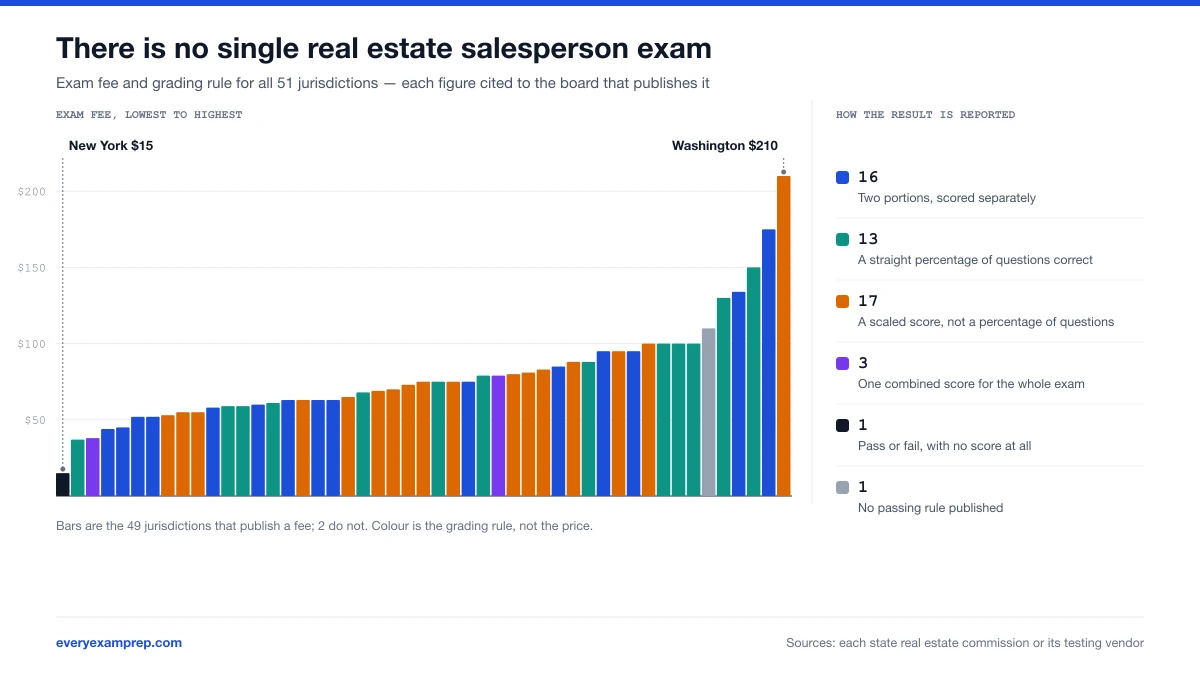
There is no national real estate exam: each state board sets its own fee, length and passing rule, and most pair a national portion with a state-law portion. The 51 jurisdictions below cite each figure to the board that publishes it — exam fees run from $15 to $210, and exams run 100 to 154 questions. A dash means the board publishes no fixed figure.
9 states title the entry-level licence broker rather than salesperson — Colorado, Illinois, Indiana, New Mexico, North Carolina, Oregon, South Dakota, Tennessee and Washington. Those rows link to a page named “Broker Exam,” but it is the first licence you sit for in that state, not an upgrade.
| State | Exam fee | Questions | Time | Passing | Board |
|---|---|---|---|---|---|
| Alabama | $73 | — | 3h 30m | Scaled 70 on a 0-100 scale | Alabama Real Estate Commission |
| Alaska | $100 (state fee page; the vendor handbook separately lists $115) | — | 4h | Scaled 75 (0-100 scale) | Alaska Real Estate Commission |
| Arizona | $130 (General $70 + State $60) | 140 | 4h | 75% | Arizona Department of Real Estate |
| Arkansas | $75 (separate $50 resident application fee and $25 recovery-fund fee) | — | — | Scaled 70 | Arkansas Real Estate Commission (AREC) |
| California | $100 | 150 | 3h | 70% | California DRE |
| Colorado | $45 ($44.95 first-time; $42.50 retake) | 154 | 3h 50m | National 60/80 + State 53/74 correct (both required) | Colorado Division of Real Estate (DORA) |
| Connecticut | $59 (first attempt; $51 retake; $80 application fee separate) | — | — | 70% | Connecticut Department of Consumer Protection (Real Estate Commission) |
| Delaware | $88 | — | 4h | Scaled 70 (0-100 scale) | Delaware Real Estate Commission |
| District of Columbia | $79 | — | — | 75% | District of Columbia Real Estate Commission (DLCP) |
| Florida | $37 (Pearson VUE fee) | 100 | 3h 30m | 75% | Florida DBPR / FREC |
| Georgia | $175 | 152 | — | Pass required on both portions (100 national + 52 state) | Georgia Real Estate Commission (GREC) |
| Hawaii | $61 | 130 | 4h | 70% | Hawaii Real Estate Commission |
| Idaho | $83 | — | 4h | Scaled 70 (0-100 scale) | Idaho Real Estate Commission |
| Illinois | $55 | 140 | 3h 30m | 75 (scaled, each portion) | Illinois IDFPR |
| Indiana | $55 | 145 | 4h | Scaled 75 | Indiana Professional Licensing Agency (Indiana Real Estate Commission) |
| Iowa | $95 | 120 | 3h | 70% on each portion (national 56 of 80; state 28 of 40) | Iowa Real Estate Commission |
| Kansas | $70 | — | — | Scaled 70 (0-100 scale) | Kansas Real Estate Commission |
| Kentucky | $100 | 120 | 4h | 75% | Kentucky Real Estate Commission |
| Louisiana | $81 (combined national + state first attempt) | 135 | 4h | Scaled 70 on each portion (0-100 scale) | Louisiana Real Estate Commission |
| Maine | $88 (separate $121 application fee (includes $21 criminal records check)) | — | — | 75% | Maine Real Estate Commission |
| Maryland | $44 | 110 | 2h | 70% (national 56 of 80; state 21 of 30, scored separately) | Maryland Real Estate Commission (MREC) |
| Massachusetts | $85 (mass.gov salesperson candidate fee; PSI's bulletin separately lists $56 per exam attempt) | — | 4h | 70% on each portion (general + state) | Massachusetts Board of Registration of Real Estate Brokers and Salespersons |
| Michigan | $79 | 115 | 3h | 70% (80 of 115 raw points — single combined exam) | Michigan Department of Licensing and Regulatory Affairs (LARA) |
| Minnesota | $68 (combined general + state sitting; $45 per portion when taken separately) | 130 | 4h | 75% | Minnesota Department of Commerce |
| Mississippi | $75 | 120 | 4h | General portion 70% (56 of 80); state portion 75% (30 of 40) | Mississippi Real Estate Commission |
| Missouri | $52 | — | — | National portion 70%; state portion 75% | Missouri Real Estate Commission |
| Montana | $95 (per portion) | — | — | Scaled 75 on each portion | Montana Board of Realty Regulation |
| Nebraska | $150 (separate $175 application fee) | — | 4h | 75% | Nebraska Real Estate Commission |
| Nevada | $100 (single portion or two-for-one national + state combination) | — | 4h | 75% | Nevada Real Estate Division (NRED) |
| New Hampshire | — | 120 | 4h | National 56 of 80; state 28 of 40 (combined sitting 84 of 120) | New Hampshire Real Estate Commission (Office of Professional Licensure and Certification) |
| New Jersey | $38 (PSI exam fee; $160 initial salesperson license fee is separate) | 110 | 4h | 70% (77 of 110 correct — single combined exam) | New Jersey Real Estate Commission |
| New Mexico | $95 | — | — | 75% (national 60 of 75; state 38 of 50, scored separately) | New Mexico Real Estate Commission |
| New York | $15 (written exam fee) | — | 1h 30m | Pass/Fail (no numeric score reported) | New York State Department of State, Division of Licensing Services |
| North Carolina | $63 | 140 | 4h 30m | 75 (each section) | North Carolina Real Estate Commission |
| North Dakota | $134 (covers one or both portions in a sitting) | — | — | National 70 of 100; state 30 of 40 | North Dakota Real Estate Commission |
| Ohio | $63 (exam fee; separate $81 application fee) | 120 | 3h | 70% scaled on each portion (80 national + 40 state) | Ohio Division of Real Estate and Professional Licensing |
| Oklahoma | $75 (per registration order; separate $35 application processing fee and $60 background check) | — | — | 70% scaled on each portion (national + state) | Oklahoma Real Estate Commission |
| Oregon | $75 (separate $300 license application fee) | — | — | 75% on both the national and state sections | Oregon Real Estate Agency |
| Pennsylvania | $52 (national portion; state portion $49) | 120 | 3h 30m | 75% on each portion (80 national + 40 state) | Pennsylvania Real Estate Commission |
| Rhode Island | $53 (national part; state part is a separate $50 fee, each non-refundable) | — | — | Scaled 70 | Rhode Island Department of Business Regulation (Real Estate) |
| South Carolina | $63 (both portions; $55 when retaking a single portion) | 120 | 3h 20m | 70% on each portion (national 56 of 80; state 28 of 40) | South Carolina Real Estate Commission (Department of Labor, Licensing and Regulation) |
| South Dakota | — | — | — | 75% on each portion (national 90 items; state 52 items) | South Dakota Real Estate Commission |
| Tennessee | $63 (full exam; $37 national-only / $26 state-only retakes) | — | — | 70% on each portion (national 56 of 80; state 28 of 40) | Tennessee Real Estate Commission (TREC) |
| Texas | $58 | 125 | 4h | 56 national + 28 state (raw correct) | Texas Real Estate Commission |
| Utah | $69 | — | 4h | Scaled 70 on each section (general + state) | Utah Division of Real Estate |
| Vermont | $110 (national portion fee) | — | — | — | Vermont Real Estate Commission (Office of Professional Regulation) |
| Virginia | $60 (paid to PSI) | 120 | 2h 30m | National 56/80 + State 30/40 correct (both required) | Virginia Real Estate Board (DPOR) |
| Washington | $210 | — | — | Scaled 70 on each portion (national + state, per WAC 308-124A-760) | Washington State Department of Licensing (Real Estate Program) |
| West Virginia | $59 (per part) | — | — | 70% | West Virginia Real Estate Commission |
| Wisconsin | $65 | 140 | 4h | Scaled 75 on a 0-100 scale | Wisconsin Department of Safety and Professional Services / Real Estate Examining Board |
| Wyoming | $80 (per portion at a test center; $90 per portion via OnVUE remote) | — | — | Scaled 75 (0-100 scale) | Wyoming Real Estate Commission |
The single most portable mistake in real estate exam prep is carrying a number across a state line. Across the 51 jurisdictions above, boards report a result in 6 genuinely different ways, and only one of them is the percentage of questions you answered correctly. Find the shape your state uses before you set a practice-test target.
You must clear each portion on its own, and passing one usually banks it for a period while you re-sit the other. A combined average is irrelevant.
Colorado · Georgia · Iowa · Maryland · Massachusetts · Missouri · New Mexico · North Carolina · North Dakota · Oregon · Pennsylvania · South Carolina · South Dakota · Tennessee · Texas · Virginia
The most familiar shape, and the one practice tests model directly: hit the percentage on realistic questions and you are ready.
Arizona · California · Connecticut · District of Columbia · Florida · Hawaii · Kentucky · Maine · Minnesota · Mississippi · Nebraska · Nevada · West Virginia
The number the board publishes is a scaled score on a fixed range, so “70” is not “70% of questions correct.” Practice-test percentages do not map onto it.
Alabama · Alaska · Arkansas · Delaware · Idaho · Illinois · Indiana · Kansas · Louisiana · Montana · Ohio · Oklahoma · Rhode Island · Utah · Washington · Wisconsin · Wyoming
The national and state halves are added together, so a strong national score can carry a weak state one — but failing means re-sitting the entire exam, not just the half you missed.
Michigan · New Hampshire · New Jersey
There is no number to aim at and no diagnostic breakdown to study from if you fail — you get the result and nothing else.
New York
The board publishes no fixed figure; confirm the current rule with them before you register.
Vermont
A separate gap worth knowing before you build a study plan: 27 of these 51boards publish no fixed question count at all. Where the table shows a dash, the figure is not withheld here — the board does not state one, and any number you find elsewhere for those states is someone’s estimate.
The Real Estate Salesperson Exam tests knowledge across multiple domains essential to real estate practice. Candidates must understand agency relationships, including fiduciary duties summarized by OLD CAR (Obedience, Loyalty, Disclosure, Confidentiality, Accounting, and Reasonable care), and the distinctions between customer and client relationships. The exam covers the legal framework for agency termination through completion, expiration, mutual agreement, revocation, renunciation, or operation of law.
A significant portion of the exam focuses on real estate contracts and title transfer. Candidates must understand essential contract elements including competent parties, mutual assent, consideration, lawful object, and compliance with the Statute of Frauds. The exam covers contingencies for financing, inspection, and appraisal; the role of earnest money held in trust accounts; and the enforceability of time-is-of-essence clauses. For title transfer, candidates learn the distinctions among general warranty deeds (which provide the greatest protection), special warranty deeds (limited to defects during the grantor's ownership), and quitclaim deeds (which carry no warranties).
The Fair Housing Act, enacted as part of the Civil Rights Act of 1968 and amended in 1988, prohibits discrimination in sale, rental, and financing of housing based on seven federally protected classes: race, color, religion, national origin, sex, familial status, and disability. The exam covers unlawful practices including steering (channeling buyers toward or away from neighborhoods based on protected characteristics), redlining (denying loans or insurance in certain areas), blockbusting (inducing owners to sell by suggesting people of a protected class are moving in), and discriminatory advertising. Candidates must also know that the Civil Rights Act of 1866 prohibits all racial discrimination in property transactions with no exemptions, and that certain exemptions like the Mrs. Murphy exemption for small owner-occupied buildings cannot override these protections when a licensee is involved.
Financial concepts are central to the exam, including mortgage security (where a mortgage or deed of trust pledges property as collateral), the distinction between fixed-rate and adjustable-rate mortgages, and loan types such as conventional, FHA, and VA loans. Candidates learn about discount points (prepaid interest reducing the note rate), PMI requirements on conventional loans with down payments below 20 percent, due-on-sale clauses, and amortization schedules where early payments are mostly interest. Valuation methods include the gross rent multiplier and income capitalization approach for income properties.
Prelicensing education is required before taking the exam. The amount of required coursework varies significantly by state, ranging from 63 hours in Florida to 180 hours in Texas. Candidates should complete their state's specific prelicensing requirements before scheduling their examination.
The exam fee is paid to the testing vendor the state contracts — PSI in California, Pearson VUE in Florida, the state's own eAccessNY system in New York — and it is separate from the licence application fee the board charges once you pass, and separate again from the pre-licensing course. Exam fees alone run from $15 in New York, where the state administers a short written test itself, to $37 at Pearson VUE in Florida and higher in states that price the national and state portions as two registrations. The state table on this page carries every published fee.
Budget for the retake as well as the first attempt: a candidate who passes one portion and fails the other pays a reduced fee to re-sit the failed portion in most states, and the number of attempts allowed before the pre-licensing course must be repeated is a state rule. Confirm the current fee on the board's or vendor's page linked from the state's exam guide, because vendors revise fees on their own schedule.
Length and timing are state decisions, and the spread is wide. Florida's exam is 100 questions in 3 hours 30 minutes as a single combined sitting; New York's is a 90-minute state-written test with no separately scored national portion and no published question count; the vendor-built exams in most other states pair a national portion of 80 questions with a state portion of 30 to 50, for 110 to 150 questions in two to four hours — the table above has each state's total and time limit. Every question is multiple choice with four options.
Scoring follows the portion structure. Where the portions are scored separately, each has its own passing mark — 70% in California, for example — and passing one portion is banked for a period the board sets while the other is retaken. Where the exam is a single combined test, such as Florida's, one score decides the result. Results are reported at the test centre on the day for the vendor-delivered exams; New York reports pass or fail only, with no numeric score. The exact numbers for each state are in the table above, read from the state's own page.
1 statements, each bound to the official document it was taken from. The source link beside every line opens that document.
This page compares free study options for the real estate salesperson exam against paid courses and books, so you can spend money only where it actually moves your score. Because a passing score in the 70%-75% range is commonly required (the exact bar depends on your state) and pre-licensing education is mandatory before you can sit for the exam, your prep should map directly to those two realities: cover the required coursework, then drill until you clear your state's passing bar consistently.
| Factor | Free resources | Paid courses & books |
|---|---|---|
| Cost | $0 — official candidate handbooks, state real estate commission outlines, free practice questions, YouTube walkthroughs, and study guides like this one. | Typically ranges from a modestly priced review book to a full prep course; verify current pricing with the provider. |
| Structure | Self-directed. You assemble your own study plan and sequence. | Guided curriculum, scheduled lessons, and progress tracking. |
| Practice depth | Limited free question banks; may not mirror the real exam's breadth. | Large, exam-aligned question banks with rationales and timed mock exams. |
| Support | Community forums; no personal feedback. | Instructor support, tutoring, and sometimes a pass guarantee. |
| Best for | Disciplined self-starters, budget-limited candidates, and topping up weak areas. | Candidates who want accountability, are short on time, or struggle with self-study. |
Consider combining both: complete the mandatory pre-licensing education, use free official handbooks and this guide to learn the material, then add one paid, exam-aligned practice bank if free questions leave you short of a consistent 70%. This keeps spending focused on the single component — realistic practice — that most reliably closes the gap to a passing score.
Our page on each provider below lists its published prices with the date we checked them, what it does better than free prep, and where the free path here is enough.
A walkthrough of national real estate practice exam questions with answers and explanations.
Source: Real Estate Exam Ninja (YouTube)
A tutor works through real estate math problems commonly seen on the licensing exam, step by step.
Source: PrepAgent (YouTube)
A review of real estate contracts with multiple-choice practice questions for the national exam.
Source: PrepAgent (YouTube)
Free episodes from the Every Exam Prep podcasts that cover the Real Estate Salesperson exam. Each one opens on Apple Podcasts.
Real Estate Exam Prep · Sep 8, 2026 · 6 min
Real Estate Exam Prep · Sep 3, 2026 · 6 min
Real Estate Exam Prep · Aug 22, 2026 · 5 min
Real Estate Exam Prep · Aug 22, 2026 · 6 min
You multiply the sale price by the commission rate. The State Real Estate Commission's outline gives exactly this example: a property that sells for 300,000 dollars at a six percent rate generates an 18,000 dollar commission. Commission math appears alongside proration and loan-to-value work, and the free practice test on this page drills it inside the Financing and Contracts sections.
Yes. The State Real Estate Commission requires completion of pre-licensing education hours prior to sitting for the salesperson exam, so the coursework comes before the test date rather than after it. Once you are eligible, the practice test here lets you work through Contracts, Property Ownership, Financing and State Law questions in the same subject mix the exam uses.
You need the loan-to-value ratio, which the State Real Estate Commission defines as the loan amount divided by the lesser of the appraised value or purchase price, expressed as a percentage. Its worked example is a 240,000 dollar loan on a 300,000 dollar property, which is 80 percent LTV. Questions in the Financing section of the practice test set up the same calculation from a sale price and a loan figure.
A licensee who represents both the buyer and the seller in one transaction is a dual agent, and the State Real Estate Commission treats that as legal only with the informed written consent of both parties. A dual agent also cannot advocate for one party against the other. Confidentiality still applies, so you may not reveal the seller's lowest acceptable price, and it survives termination of the agency.
Proration divides shared expenses such as property taxes, rent, or interest between buyer and seller based on the portion of the period each party owns the property, with the closing date as the dividing point. The State Real Estate Commission notes that many exams use a 360-day banker's year with 30-day months, so the daily rate is the annual amount divided by 360. Where the seller prepaid an expense the buyer reimburses the unused portion, and where an expense is paid in arrears the seller credits the buyer.
Recording a deed in the county land records gives constructive notice to the world of the grantee's interest and establishes priority, generally protecting the first party to record. Delivery still matters too: a deed transfers title only when it is delivered to and accepted by the grantee. Title insurance is the separate protection, covering losses from covered title defects that existed but were unknown when the policy issued.
The official documents our facts about this exam are taken from.
Last verified against Internal Revenue Service's official sources:
Each card collects one exam’s study resources with their counts, so you can see what every exam in the family offers.