Securities & FINRA
FINRA and NASAA licensing exams for the securities industry.
18 exams · 3,215 free practice questions · Verified against official sources October 4, 2026
- Exams
- 18
- Exam families
- 4
- Free practice questions
- 3,215
- Study guides
- 18
- Cheat sheets
- 18
Which exam are you taking?
Exams are grouped with their close relatives — the other tiers of the same licence, the same exam in other states. Open a group to see each exam with its free practice questions, study guide and cheat sheet.
- FINRA Series exams11 exams1,980 free questionsThe core FINRA qualification exams.Series 7SIESeries 6Series 26+7 moreExplore FINRA Series exams →
- Futures & commodities exams3 exams247 free questionsNFA-owned futures and commodities qualification exams.Series 3Series 30Series 34Explore Futures & commodities exams →
- Municipal securities exams1 exam104 free questionsMSRB-owned municipal securities qualification exams.Series 50Explore Municipal securities exams →
- NASAA state exams3 exams884 free questionsNASAA-owned uniform state securities law exams, delivered via FINRA.Series 65Series 63Series 66Explore NASAA state exams →
Which securities exam do you need?
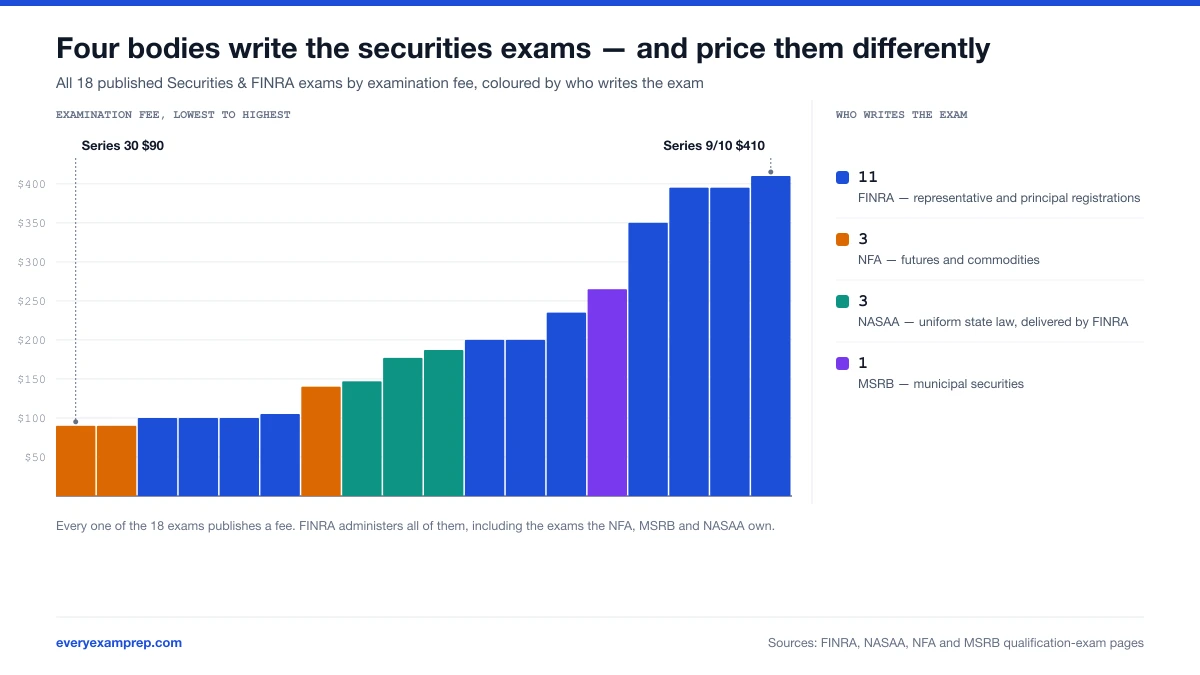
Four organizations write the exams on this page, and the first thing to settle is which one governs the job you want. FINRA writes and administers the SIE and the Series exams that qualify representatives and principals at broker-dealers. NASAA, the association of state securities regulators, writes the state-law exams (Series 63, 65 and 66), which FINRA administers on its behalf. The futures exams (Series 3 and its narrower siblings) belong to the National Futures Association, and the municipal exams (Series 50 through 54) to the MSRB — FINRA delivers those too, but the requirements come from the NFA and the MSRB.
Every exam here is a qualification exam, not a course. You do not enrol in a class; you register for a test, sit it at a Prometric center or online where the regulator allows it, and the pass qualifies you for a specific registration. Which registration your firm and your state require decides the exam, so the table below starts from the job rather than the exam number.
One rule of the current FINRA structure shapes everything else: representative qualification is split in two. The SIE covers industry-wide knowledge and is open to the public. A representative-level exam then covers the specific registration — general securities, investment company products, investment banking, operations — and can only be taken through a sponsoring firm. Principal exams for supervisors sit above that and require a representative-level pass first.
Start from the job
Find your situation in the left column. The exam column links to the exam guide, where the format, fee and passing standard are verified against the regulator's own page.
The SIE is the one exam you can take without a sponsor: association with a firm is not required and there is no prerequisite. A pass stays valid for four years while you find a firm, but on its own it does not qualify you for registration.
Series 6 is the limited representative exam for investment company and variable contracts products. It requires association with and sponsorship by a FINRA member firm, and the SIE is its co-requisite.
The Series 7 needs a sponsoring firm, and you must pass both the SIE and the Series 7 to hold the General Securities Representative registration. It covers everything the Series 6 does and more, so most firms skip the 6 for full-service roles.
The Series 63 is NASAA's state-law test for broker-dealer agents and is usually paired with a Series 6 or 7. If you will also give investment advice at the same firm, the Series 66 covers the state-law and adviser-law content together and is taken with the Series 7.
The Series 65 is the Uniform Investment Adviser Law Examination and has no prerequisite or co-requisite, so you can sit it with no sponsor. Candidates who hold or are taking the Series 7 use the Series 66 instead.
Each is a representative-level exam for one registration: Series 79 for investment banking, Series 82 for private securities offerings, Series 57 for securities traders, Series 99 for operations professionals. All need a sponsoring firm and the SIE.
Principal exams. The Series 24 (general securities principal) requires the SIE and an appropriate representative-level exam such as the Series 7 first, and enrollment goes through the firm. Series 26 covers investment company products supervision, Series 9/10 sales supervision, Series 4 options supervision.
The Series 3 is an NFA exam administered by FINRA, with no prerequisite. It is the primary exam for futures commission merchants, introducing brokers, commodity pool operators, commodity trading advisors and their associated persons.
The Series 50 must be passed before engaging in municipal advisory activities and has no prerequisite or co-requisite. The Series 52 qualifies municipal securities representatives and the Series 53 their principals, under MSRB Rule G-3.
What has to come before what
- 01Take the SIE first if you have no firm. It needs no sponsor and no prerequisite, its result is valid for four years, and every FINRA representative-level exam requires it as a co-requisite.
- 02Get sponsored for the representative-level exam. Series 6, 7, 22, 57, 79, 82, 86/87 and 99 all require that you are associated with and sponsored by a FINRA member firm; the firm enrolls you, so self-enrollment is not offered for these.
- 03Add the state-law exam your state requires. Most states ask broker-dealer agents for the Series 63 alongside the Series 6 or 7; if you also give advice, the Series 66 replaces the 63 and the 65 together.
- 04Principal exams come last. The Series 24, for example, requires the SIE and an appropriate representative-level exam such as the Series 7 before you can sit it.
- 05The NFA and MSRB tracks stand apart from this ladder. The Series 3 and the Series 50 each have no prerequisite exam, and neither requires the SIE.
Fee, format and passing standard
The 10 exams asked about most, of 18 on this page. Each figure is that exam's verified fact, cited to the regulator's page on the exam guide it links to. A blank cell means the regulator publishes no fixed figure.
| Exam | Fee | Questions | Time | Passing | Written by |
|---|---|---|---|---|---|
| SIE | $100 | 75 | 1h 45m | 70% | FINRA |
| Series 6 | $100 | 50 | 1h 30m | 70% | FINRA |
| Series 7 | $395 | 125 | 3h 45m | 72 | FINRA |
| Series 63 | $147 | 65 | 1h 15m | 72% | NASAA |
| Series 65 | $187 | 130 | 3h | 92 of 130 (71%) | NASAA |
| Series 66 | $177 | 100 | 2h 30m | 73% | NASAA |
| Series 79 | $395 | 75 | 2h 30m | 73% | FINRA |
| Series 24 | $235 | 150 | 3h 45m | 70% | FINRA |
| Series 3 | $140 | 120 | 2h 30m | 70% each part | NFA |
| Series 50 | $265 | 100 | 3h | 71% | MSRB |
Who writes these exams
- FINRA
- Writes and administers the SIE and the Series exams for broker-dealer representatives and principals, sets registration requirements under Rule 1210, and delivers the NASAA, NFA and MSRB exams at its test vendor.
- NASAA
- The North American Securities Administrators Association — the state regulators. It develops the Series 63, 65 and 66 and sets the waiting periods and continuing-education rules for investment adviser representatives; FINRA administers the exams for it.
- National Futures Association (NFA)
- The self-regulatory organization for the U.S. derivatives industry. The CFTC has delegated registration to the NFA, whose proficiency requirements name the Series 3 as the primary futures exam.
- MSRB
- The Municipal Securities Rulemaking Board. Its Rule G-3 defines the municipal securities and municipal advisor classifications that the Series 50 through 54 qualify.
Official pages this section is drawn from
- FINRA · Qualification Exams
- FINRA · Securities Industry Essentials (SIE) Exam
- FINRA · Co-requisites for Qualification Exams
- FINRA · Enroll for an Exam
- FINRA · Series 7 – General Securities Representative Exam
- FINRA · Series 24 – General Securities Principal Exam
- FINRA · FINRA Rule 1210 – Registration Requirements
- NASAA · NASAA Exams – Series 63, 65 and 66
- NASAA · General Exam Information – Series 63, 65, 66
- National Futures Association · Proficiency Requirements
- MSRB · Series 50 – Municipal Advisor Representative Qualification Examination
- MSRB · MSRB Rule G-3: Professional Qualification Requirements
Securities & FINRA articles
All articles →Pass-rate breakdowns and independent prep-course comparisons for securities & finra exams. Every figure links back to the body that publishes it.
- SIE Requirements (2026): Who Qualifies & HowSecurities Industry Essentials (SIE) eligibility explained: prerequisites, sponsorship and education requireme…
- Series 7 Exam Changes 2026: What's Different NowWhat changed on the General Securities Representative Exam (Series 7), when it takes effect, who it applies to…
- Series 7 Exam Cost in 2026: The Full BillWhat the General Securities Representative Exam (Series 7) actually costs in 2026 — the exam fee, what else is…
- Best Series 7 Prep Courses: Self-Study, QBank & Live SupportCompare Series 7 course materials, access periods and instructor support. Includes dated provider pricing and …
- SIE Pass Rate: What the 2019 Figures Mean in 2026The 74% SIE pass rate is a 2019 figure FINRA presented at a conference, not a current rate. What FINRA’s pages…
- How Many Times Can You Take the SIE or Series 7? (2026)No cap on attempts: wait 30 days after a failed SIE or Series 7, 180 after a third. NASAA's 63/65/66 third-fai…
Frequently asked questions
Start with the SIE — it is open to the public with no firm sponsorship, and results stay valid for 4 years. Then take the representative exam your job requires (Series 6 or Series 7, both sponsor-required), pairing it with the NASAA state-law exam your role needs: Series 63, 65, or 66.
Two paths need no sponsor: the SIE, which anyone can register for, and the NASAA state-law exams (Series 63, 65, 66), which allow self-enrollment. The Series 6 and Series 7 require sponsorship by a FINRA member firm.
The SIE and Series 6 are $100 each, the Series 63 is $147, the Series 66 is $177, the Series 65 is $187, and the Series 7 is $395. Sponsoring firms often cover the fee; a retake means paying it again.
A passing score is not a pass rate, and the two get mixed up constantly. The regulators publish a passing score for every exam on this page — it runs 68% to 74% depending on the exam, and it is a fixed bar, not a curve against other candidates. A current, regulator-published pass rate is a different matter: we have not found one for these exams, so treat any quoted "X% of candidates pass" as somebody's estimate. Judge difficulty by scale and prerequisite instead. The SIE is 75 questions in 1 hour 45 minutes and needs no sponsor; the Series 7 is 125 questions in 3 hours 45 minutes and needs both the SIE and a sponsoring firm; the Series 9/10 runs 200 questions across two parts. Use the published passing score as your practice-test target.
Official sources
Every exam number on this page traces to a document published by the body that sets or administers the exam. These are the primary publishers cited across Securities & FINRA.
- FINRAfinra.orgcited by 18 exams
- NASAAnasaa.orgcited by 4 exams
- NFAnfa.futures.orgcited by 3 exams
- MSRBmsrb.orgcited by 1 exam
- U.S. Bureau of Labor Statisticsbls.govcited by 1 exam
Last verified against these documents:
What you'll find on every Securities & FINRA exam
Each exam has up to four pages, one per job to be done: practice the questions, understand the exam, study the outline, or revise the morning of. Flashcards and glossary terms sit inside the study guide rather than on pages of their own.
- Practice tests18
- Free question banks with a worked explanation on every answer.
- Exam guides18
- Cost, format, eligibility and difficulty, straight from the official outline.
- Study guides18
- Full outline coverage, plus the exam's flashcards and glossary terms.
- Cheat sheets18
- One-page summaries built for the last review, with a PDF download.