Texas Real Estate Broker Exam
The Texas Real Estate Broker Exam is the licensure examination required by the Texas Real Estate Commission to qualify as a real estate broker in Texas. Brokers hold a higher level of responsibility than sales agents, serving as the licensed individual who employs agents, maintains trust accounts, and oversees compliance with Texas real estate law. Anyone seeking to become a broker in Texas must pass this exam after meeting specific experience and education requirements.
The broker license opens the door to independent practice, employment of agents, and management of real estate transactions. This exam tests both national real estate principles and Texas-specific statutes, rules, and regulations. Passing the exam is the gateway to operating a real estate brokerage firm and managing the legal and financial responsibilities that come with broker-level authority.
Exam Content and Structure
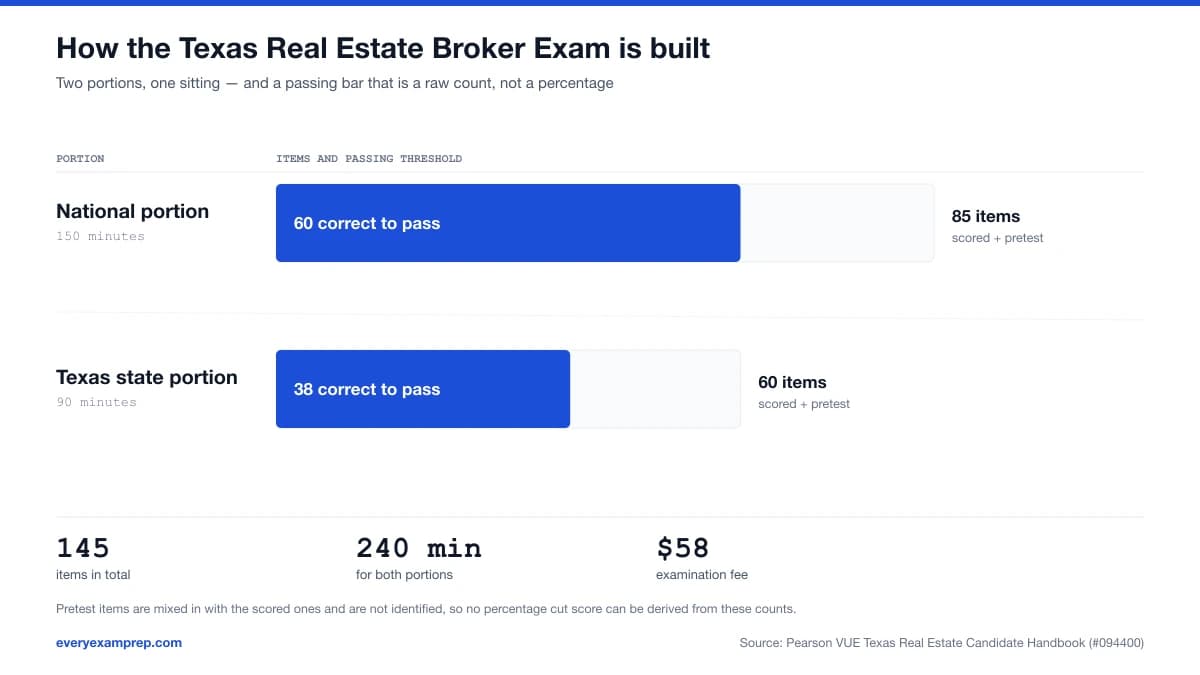
The Texas Real Estate Broker Exam is divided into two parts: a national portion and a Texas state portion. The national portion contains 85 scored and pretest items and covers property ownership, land use controls and regulations, valuation and market analysis, financing, laws of agency, contracts, and transfer of title. The state portion contains 60 items and focuses on the duties and powers of the Texas Real Estate Commission, licensing requirements, and Texas statutes and rules governing agency and trust accounts.
In total, candidates answer 145 questions over a 240-minute testing period. The exam is administered by Pearson VUE and must be scheduled in advance; walk-in examinations are not available.
Eligibility and Prerequisites
To qualify for the broker exam, applicants must be at least 18 years of age. More significantly, applicants must have at least four years of active experience as a licensed sales agent or broker during the 60-month period preceding the application. This experience must total 720 points.
Education is also a mandatory requirement. Broker applicants must complete 270 classroom hours of qualifying real estate courses. Additionally, they must complete 630 classroom hours in related qualifying courses or approved continuing education. Meeting these education and experience thresholds demonstrates that candidates bring practical knowledge to the licensing examination.
Cost and registration
The Texas Real Estate Broker Exam fee is $58 USD. This fee is charged per examination attempt. Candidates should be aware that if they fail the exam, they must wait at least twenty-four hours before scheduling a re-examination, and the retake fee is the same. For candidates who fail three times, additional education is required: thirty hours for one failed portion or sixty hours for both failed portions.
Exam format
The exam contains 145 total questions and must be completed within 240 minutes. Candidates should report to the test center at least thirty minutes before the examination begins. The national portion has 85 scored and pretest items, while the state portion contains 60 items. Passing requires a score of 60 correct answers on the national portion and 38 correct answers on the state portion.
The exam is delivered by Pearson VUE, and all candidates must make an online reservation at least twenty-four hours before the desired examination date. Once the exam is passed and the background check is cleared, candidates receive their license document from the Texas Real Estate Commission by email within 5-10 business days.
Verified facts about the Texas Real Estate Broker exam
19 statements, each bound to the official document it was taken from. The source link beside every line opens that document.
Requirements and rules
- After failing three times, candidates must complete additional qualifying education of thirty hours for one failed portion or sixty hours for both failed portions.
- Pearson VUE
- The required active experience must total 720 points.
- Texas Real Estate Commission (TREC)
- Applicants must have at least four years' active experience as a licensed sales agent or broker during the 60-month period preceding the application.
- Texas Real Estate Commission (TREC)
- The Texas Real Estate Commission (TREC) is the state agency that regulates and licenses real estate brokers in Texas.
- Texas Real Estate Commission (TREC)
- A broker applicant must be 18 years of age or older.
- Texas Real Estate Commission (TREC)
- Walk-in examinations are not available; candidates must schedule in advance.
- Pearson VUE
- Broker applicants must complete 270 classroom hours of qualifying real estate courses.
- Texas Real Estate Commission (TREC)
- Broker applicants must complete an additional 630 classroom hours in related qualifying courses or approved continuing education.
- Texas Real Estate Commission (TREC)
- Candidates should report to the test center at least thirty minutes before the examination begins.
- Pearson VUE
- Candidates must make an online reservation at least twenty-four hours before the desired examination date.
- Pearson VUE
- Candidates who fail must wait twenty-four hours before scheduling a re-examination.
- Pearson VUE
- Pearson VUE administers the Texas real estate broker licensure examination on behalf of the Texas Real Estate Commission.
- Pearson VUE
- Pretest questions are mixed in with the scored questions and are not identified; responses to them do not affect a candidate's score.
- Pearson VUE / TREC
- TREC enforces the Real Estate License Act and Commission rules and accepts complaints alleging violations.
- Texas Real Estate Commission (TREC)
Numbers
- Candidates who pass and clear the background check receive a license document from TREC by email within 5-10 business days.
- Pearson VUE
- The broker national portion contains 85 scored and pretest items.
- Pearson VUE
- The broker state portion contains 60 items.
- Pearson VUE
What is tested
- The national portion covers property ownership, land use controls and regulations, valuation and market analysis, financing, laws of agency, contracts, and transfer of title.
- Pearson VUE
- The Texas state portion covers the duties and powers of the Texas Real Estate Commission, licensing requirements, and Texas statutes and rules governing agency and trust accounts.
- Pearson VUE
How hard is it?
The Texas Real Estate Broker exam is a genuine step up from the salesperson license—it requires deeper knowledge of trust accounting, agency law, and brokerage compliance, plus significantly more hands-on experience. If you're coming from a sales agent background, expect to study longer and prepare for a more rigorous test of operational and legal fundamentals. It's passable with targeted preparation, but not a casual sprint.
Passing Score & Difficulty
You must answer at least 60 questions correctly on the National examination and 38 on the State examination. Both are raw counts, not percentages: the 85 national and 60 state items include unscored pretest questions that Pearson VUE does not identify, so there is no published percentage to aim at. The two scores are separate: you can pass one and fail the other, then retake only the failed section.
The Cost to Get Licensed
The exam fee itself is just $58—one of the cheapest hurdles. But the total cost to reach the broker license is far steeper. The 900 hours of required coursework typically costs $1,500 to $4,000 depending on your school and whether you bundle packages. If you haven't already completed some related education as a sales agent, you may need to add hundreds more in prerequisite courses. You also need to budget for a background check and may face a processing delay: candidates who pass and clear the background check receive a license document from TREC by email within 5-10 business days.
Study Plan & Timeline
A realistic study plan assumes you already hold a Texas sales agent license and have exposure to the core concepts. Start 8 to 12 weeks before your exam date. Spend the first 4 weeks on national content: real estate law, contracts, agency, financing, and valuation. These topics overlap with the salesperson exam but go deeper into broker-specific responsibilities and regulatory nuances. Allocate 2 weeks to Texas state law, TREC rules, and trust account mechanics. Use the final 2 weeks for mixed practice exams and drilling weak areas. Aim to score consistently above 75% on practice tests before sitting for the real exam.
If you fail one section, you must wait at least 24 hours before scheduling a re-examination. After three failures on the same section, TREC requires additional qualifying education: 30 hours if you failed one portion, or 60 hours if you failed both. That penalty adds weeks to your timeline and hundreds more in course fees, so getting it right on your first or second attempt saves both time and money.
Exam Day Logistics
You must make an online reservation at least 24 hours before your exam date through Pearson VUE, the testing vendor. Walk-in examinations are not available, so no showing up on a whim. Plan to report to the test center at least 30 minutes early to complete check-in, security verification, and briefing. Bring your confirmation email, a valid government ID, and any required admission documents. The exam is proctored, your workspace is monitored, and you cannot bring study materials, phones, or personal devices into the testing room.
What Makes This Exam Hard
Prepare for three things. First, the state portion is deceptively granular: it's not broad real estate concepts but narrow Texas regulatory minutiae—specific TREC rule violations, trust account deposit timelines, and licensing status scenarios that feel like gotchas if you haven't memorized the rules. Second, the national section tests application and scenario judgment, not just recall: you'll face questions about dual agency consent, fiduciary duty conflicts, and proper handling of earnest money that reward deep understanding, not surface knowledge. Third, time pressure is real—2 minutes per question leaves little margin for hesitation, so if you haven't drilled practice exams under timed conditions, you'll likely run over.
Career Value & ROI
A Texas broker license opens doors: you can operate your own brokerage, hire and supervise sales agents, keep a higher share of commissions, and access commercial and team structures that aren't available to independent sales agents. Top brokers in Texas earn six figures, though your actual income depends on your market, your company's culture, and your client base. The upfront cost—both in time and money—is substantial: 900 hours of courses, the exam fee, and the background check probably cost $2,000 to $5,000 total, and the opportunity cost of 8 to 12 weeks of prep is real. But if you're serious about building a business or managing a team, the broker license is the prerequisite that makes that possible.
Compared with related exams
The Texas Real Estate Broker Exam sits at the top of the licensing ladder — a broker license authorizes you to operate independently and supervise sponsored agents, which is why the exam is broader and more demanding than the entry-level salesperson and sales-associate exams it's compared against here. This page maps the Texas Broker Exam against four related credentials so you can see exactly how scope, difficulty, and prerequisites differ before you commit study time.
All five exams share a two-part structure (a national/general portion plus a state-law portion), but they diverge sharply in who they're for and what you must complete before you're even eligible to sit.
At a glance
The Texas Real Estate Broker Exam is a state-licensing exam delivered by Pearson VUE. It runs 240 minutes and includes 145 questions, with a fee of $58. To pass the national portion you must answer 60 questions correctly. The four exams below are its closest peers.
Scope
- Texas Real Estate Broker Exam — Broadest scope. Covers everything a salesperson must know plus brokerage operations, agency supervision, trust-account management, and advanced contract and finance topics. A broker can work independently and sponsor other license holders.
- Texas Real Estate Sales Agent Exam — The entry-level Texas credential. Same national real-estate principles, but the state portion and overall depth are narrower; a sales agent must work under a sponsoring broker.
- California Real Estate Salesperson Exam — California's entry-level exam. Covers national principles plus California-specific law; a salesperson works under a broker.
- California Real Estate Broker Exam — California's top-tier exam, parallel to the Texas broker exam but built around California statutes and DRE rules; authorizes independent practice and supervision.
- Florida Real Estate Sales Associate Exam — Florida's entry-level exam, covering national principles plus Florida-specific law; a sales associate works under a broker or owner-developer.
Difficulty
As a rule, broker exams are harder than salesperson/sales-agent exams because they add supervisory, trust-accounting, and brokerage-operations material on top of the same fundamentals. So the Texas Broker Exam and the California Broker Exam are the two toughest in this set, while the Texas Sales Agent, California Salesperson, and Florida Sales Associate exams test a comparatively narrower body of knowledge. The Texas Broker Exam's 240-minute, 145-question format reflects that added breadth.
Who each is for
- Texas Real Estate Broker Exam — Experienced Texas agents ready to run their own brokerage, hold escrow, and sponsor agents.
- Texas Real Estate Sales Agent Exam — Newcomers entering Texas real estate under a sponsoring broker.
- California Real Estate Salesperson Exam — Newcomers entering California real estate under a broker.
- California Real Estate Broker Exam — Experienced California agents advancing to independent practice.
- Florida Real Estate Sales Associate Exam — Newcomers entering Florida real estate under a broker or developer.
Prerequisites
Because a broker credential is an advancement, the two broker exams generally sit behind more coursework and prior experience than the entry-level exams. In practical terms, a candidate typically earns and works under a salesperson/sales-agent license first, then completes additional broker-level education before qualifying for a broker exam. The entry-level exams — Texas Sales Agent, California Salesperson, and Florida Sales Associate — are the natural starting points and require only the qualifying pre-license education for that state. Because exact hour requirements, experience windows, and eligibility rules are set by each state's licensing authority and change over time, confirm the current prerequisites with the relevant regulator (TREC for Texas, the California DRE, or Florida's DBPR/FREC) before enrolling.
Ways to prepare
Free Resources vs. Paid Prep
Both paths can get you to a passing score. The right choice depends on your budget, your self-discipline, and how much structure you need.
Free Study Options
- Official Pearson VUE candidate handbook and content outline — the authoritative list of what the National exam actually tests. Always start here; every paid product is ultimately built to cover this same outline.
- TREC (Texas Real Estate Commission) statutes, rules, and consumer forms — free primary sources for the Texas-specific law and practice questions you'll face.
- Free practice questions and flashcards — abundant online for real estate math, terminology, agency, contracts, and finance. Repetition is what builds recall, and repetition is free.
- Free video lectures and study communities — YouTube walkthroughs and forums where recent test-takers describe question styles.
Paid Prep (Courses & Books)
- Structured prep courses — curated sequencing, progress tracking, and large question banks with rationale explanations. You pay mostly for organization and a pass guarantee.
- Exam prep books — a single edited reference that consolidates the content outline, worked math examples, and practice tests into one place.
- Live or on-demand cram sessions — instructor Q&A and accountability, useful if you struggle to stay on schedule alone.
When Each Makes Sense
- Choose free if you're a disciplined self-starter, comfortable reading primary sources, and willing to assemble your own study plan from the official outline. At a $58 exam fee, a first retake is cheaper than most courses — so free-first is a low-risk strategy.
- Choose paid if you want everything in one sequenced place, you learn better with explained answer rationales, or you value a pass guarantee and want to minimize the chance of paying the $58 fee twice.
- Hybrid (recommended for most) — study the free official outline and TREC materials as your backbone, then add one paid question bank or book to pressure-test your weak areas before test day.
Our page on each provider below lists its published prices with the date we checked them, what it does better than free prep, and where the free path here is enough.
Frequently asked questions
What is the Texas Real Estate Broker Exam?
The Texas Real Estate Broker Exam is the state licensing test you must pass to work as a licensed real estate broker in Texas. It covers both national real estate principles and Texas-specific law and rules, and it is administered at approved testing centers. Passing it is one of the final steps before the Texas Real Estate Commission issues your broker license.
How many questions are on the Texas broker exam and how long do I get?
The exam has 145 questions, and you get 240 minutes of testing time. That works out to roughly a minute and a half per question, so pacing matters. Plan your time so you can finish both the national and state portions without rushing the final sections.
How much does the Texas broker exam cost?
The exam fee is $58 each time you take the test. Keep in mind this is only the testing fee; licensing application fees and education costs are separate, so confirm the full cost breakdown with the Texas Real Estate Commission before you apply.
What score do I need to pass the Texas broker exam?
You must answer at least 60 questions correctly on the national portion of the exam. The state portion requires 38 correct answers, so you need to clear both parts, not just an overall total. Check the Texas Real Estate Commission's candidate information for the current state-portion requirement.
How do I register for the Texas broker exam?
You first apply for a broker license through the Texas Real Estate Commission, which reviews your education and experience and then makes you eligible to test. Once approved, you schedule your exam appointment with the testing provider and pay the exam fee. Follow the Texas Real Estate Commission's current application instructions, since eligibility requirements and steps can change.
Where should I start studying for the Texas broker exam?
Start with a free diagnostic set of practice questions to see where you stand before buying anything. From there, focus your study time on your weakest topic areas, such as agency, contracts, finance, and fair housing, and use a summary sheet to lock in the key rules. Free practice questions and a printable cheat sheet are available right on this site with no signup required.
How hard is the Texas Real Estate Broker Exam?
The exam is demanding mostly because of its breadth and time pressure: according to Pearson VUE, it includes 145 questions to be completed in 240 minutes. Questions span agency law, contracts, ownership, finance, fair housing, and valuation, and many test application rather than recall — for example, knowing that any material change to an offer's terms operates as a counteroffer that rejects and extinguishes the original offer. Candidates who internalize frameworks like the OLD CAR fiduciary duties (Obedience, Loyalty, Disclosure, Confidentiality, Accounting, and Reasonable care) usually find the format itself manageable.
What score do I need to pass the Texas Real Estate Broker Exam?
According to Pearson VUE, you must answer 60 questions correctly on the National examination to pass that portion. Since the full exam carries 145 items, knowing the passing threshold for the national section helps you set concrete practice-test targets before exam day.
How much does the Texas Real Estate Broker Exam cost?
The examination fee is $58, according to Pearson VUE. Because the fee is modest compared with the time invested in preparing, the smarter economy is thorough studying that lets you pass on the first attempt rather than cycling through repeat sittings.
How should I study for the Texas Real Estate Broker Exam?
Build your plan around the heavily tested legal frameworks first: a valid real estate contract requires mutual assent, consideration, legally competent parties, and a lawful object, and the Statute of Frauds requires real estate sale contracts — and leases longer than one year — to be in writing and signed by the party to be charged. Then lock down fair housing, where the federal Fair Housing Act prohibits discrimination based on seven protected classes (race, color, religion, national origin, sex, familial status, and disability) and race discrimination under the Civil Rights Act of 1866 has no exemptions. Finally, rehearse pacing under real conditions: 240 minutes for 145 questions rewards steady, practiced timing.
What finance topics come up on the broker exam?
Expect questions on loan mechanics and the federal disclosure laws. Know that one discount point equals one percent of the loan amount and is prepaid interest that buys down the interest rate, and that private mortgage insurance is typically required on conventional loans when the down payment is less than twenty percent. On the regulatory side, RESPA prohibits kickbacks and unearned referral fees and requires the Loan Estimate and Closing Disclosure, while TILA — implemented by Regulation Z — requires disclosure of the APR and total finance charge and grants a three-day right of rescission on certain refinances of a principal residence.
Sources
- 1.Texas Real Estate Broker Exam — Texas Real Estate Commission / Pearson VUE (accessed Jul 7, 2026)
- 2.Real Estate Regulatory Agencies Directory — ARELLO
- 3.Real Estate Licensing Exams (Pearson VUE) — Pearson VUE
- 4.Texas Real Estate Candidate Handbook (January 2026) — Pearson VUE (accessed Jul 18, 2026)
- 5.Become an Individual Real Estate Broker — Texas Real Estate Commission (TREC) (accessed Jul 18, 2026)
- 6.Real Estate Licensing Practice Tests — Pearson VUE
Official sources
The official documents our facts about this exam are taken from.
- Texas Real Estate Candidate Handbook, September 2026Pearson VUE / TRECpearsonvue.com
- Become an Individual Real Estate BrokerTexas Real Estate Commission (TREC)trec.texas.gov
- Texas Real Estate Licensure ExamsPearson VUEpearsonvue.com
- Welcome to TRECTexas Real Estate Commission (TREC)trec.texas.gov
- Texas Real Estate Content OutlinesPearson VUEpearsonvue.com
Last verified against Texas Real Estate Commission's official sources:
Keep going
Real Estate Broker licensing
Each card collects one exam’s study resources with their counts, so you can see what every exam in the family offers.