In this article · 8 sections
FINRA does not publish a regular Series 7 pass rate: its Series 7 page, content outline and test-center page give none (read November 15, 2026). The newest figure on record is in a rule filing FINRA made on June 29, 2026: among candidates whose first attempt was in 2024, "over 70 percent" passed the SIE, the Series 7 and the Series 24 on the first attempt. That is one statement for three exams, with no figure for the Series 7 alone. The only Series 7 figure, 71%, comes from the exam's first six months, to March 31, 2019, and survives only in a prep provider's reports of FINRA's conference presentations.
This article sets out each pass-rate statement we could trace to FINRA, with its date and what it counted. It then covers what FINRA's passing score of 72 measures, and what FINRA's own data shows candidates do after a failed first attempt.
Is there an official Series 7 pass rate?
Not a regular one. On November 15, 2026 we read FINRA's Series 7 page, its Series 7 content outline and its test-center page. They give the passing score (72), the format (125 scored questions in 3 hours and 45 minutes) and what a results report shows. None gives the share of candidates who pass, and we found no FINRA page that reports pass rates by exam or by year.
What FINRA has said sits in one rule filing and three conference presentations:
| When FINRA said it | What it said about the Series 7 | Candidates covered | Where it is recorded |
|---|---|---|---|
| March 2019, at an industry conference | 71% were successful on their first attempt | October 1, 2018 to January 31, 2019 | Knopman Marks' report, April 3, 2019 |
| May 15–17, 2019, at FINRA's Annual Conference | 71% passed on their first attempt, after passing the SIE on their first attempt; 10,542 Series 7 exams taken | October 1, 2018 to March 31, 2019 | Knopman Marks' report, May 22, 2019 |
| September 15–17, 2019, at a licensing conference | 24,675 Series 7 exams taken; the report gives no Series 7 rate | October 1, 2018 to August 31, 2019 | Knopman Marks' report, September 25, 2019 |
| June 29, 2026, in rule filing SR-FINRA-2026-014 | "Over 70 percent of individuals pass these qualification examinations on the first attempt" | First attempts in 2024 on the SIE, the Series 7 and the Series 24 | Federal Register, July 16, 2026 |
The 65% to 70% on other pages is an estimate, and the pages that give it say so. CertFuel (November 8, 2026) puts the first-time rate "around 65-70%" and calls it an industry estimate. AB Training Center (January 29, 2026) says it "hovers between 65% and 70%", drawing on "data collected from training providers and large financial firms". Neither names a dataset. Kaplan and Achievable cite the 71% from 2019 instead (all read November 15, 2026).
FINRA's 2026 filing: "over 70 percent" across three exams
The filing, SR-FINRA-2026-014, shortens the waiting periods for retaking a failed FINRA exam. FINRA filed it with the SEC on June 29, 2026, and the SEC's notice, Release No. 34-105885, ran in the Federal Register on July 16, 2026. To weigh the change, FINRA wrote that it "analyzed data from candidates with first attempts in 2024 for FINRA's three most popular qualification examinations: the SIE, the Series 7, and the Series 24 (General Securities Principal)". Its finding on first attempts is a single sentence: "Over 70 percent of individuals pass these qualification examinations on the first attempt."
Three limits are built into that sentence:
- It is a floor. "Over 70 percent" is not a rate, and FINRA gives no figure above it.
- It covers three exams in one statement. The filing does not say whether each exam clears 70 percent or the three do together, and it gives no figure for the Series 7 alone.
- It counts first attempts only, by candidates who first sat in 2024.
By subtraction, fewer than 30 in 100 of those candidates failed on the first attempt, across the three exams. It is the only pass-rate statement about the current Series 7 that we found in a document FINRA wrote itself.
After a failed first attempt: what FINRA's data shows
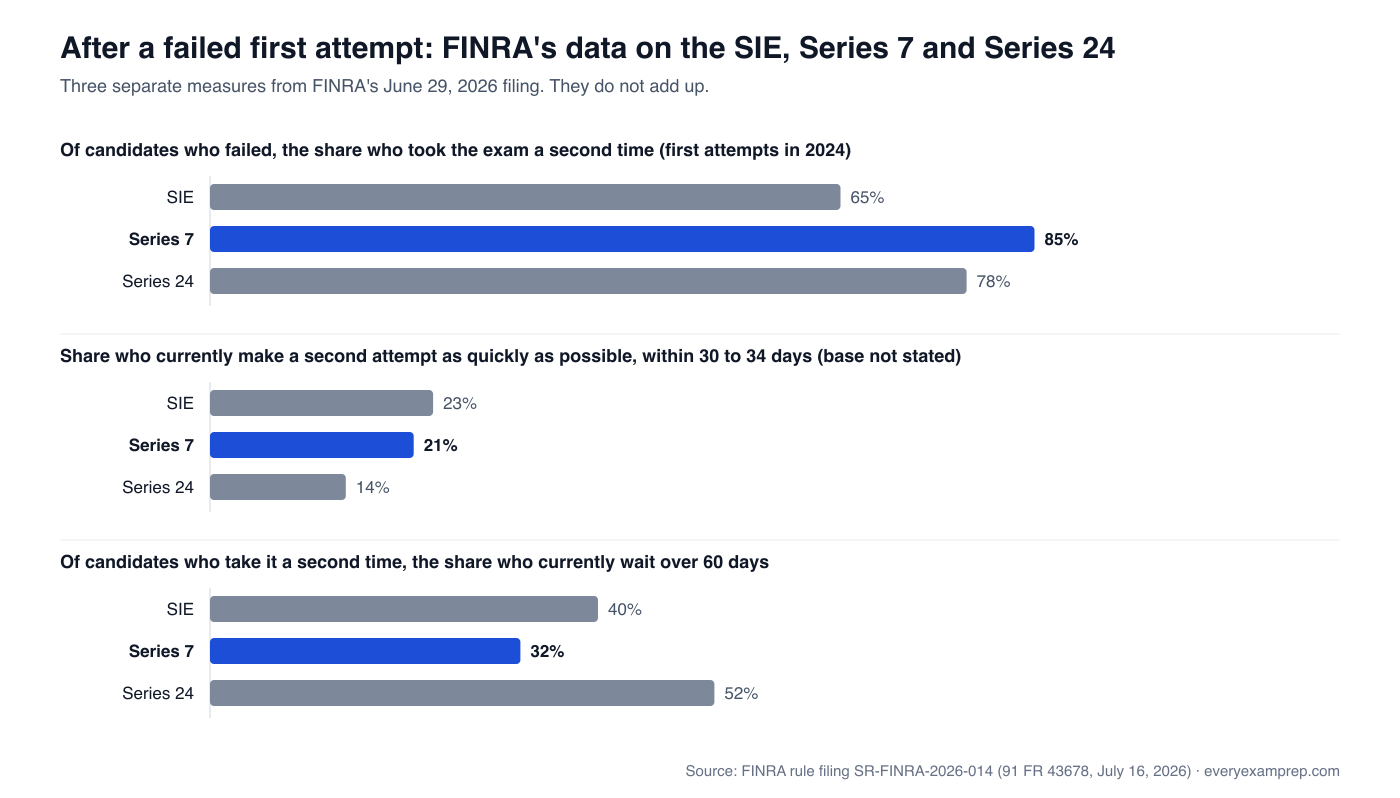
The same filing reports what candidates do after failing. Among the candidates whose first attempt was in 2024, 85 percent of those who failed the Series 7 took it a second time, the highest share of the three exams. The filing does not say why.
| Exam | Took it a second time after failing (first attempts in 2024) | Currently make a second attempt within 30 to 34 days | Of second-time takers, currently wait over 60 days |
|---|---|---|---|
| SIE | 65% | 23% | 40% |
| Series 7 | 85% | 21% | 32% |
| Series 24 | 78% | 14% | 52% |
Source for the table: FINRA's filing SR-FINRA-2026-014. FINRA ties the first column to first attempts in 2024. It words the other two as what individuals "currently" do, calls 30 to 34 days making a second attempt "as quickly as possible", and does not state whether that share is of everyone who failed or of those who tried again.
A second attempt is unlikely to repeat the first set of questions. FINRA writes that its high-volume exams "use extensive question banks that contain thousands of questions, with each test taker receiving only a small subset of questions per attempt". The filing gives no pass rate for second attempts, and on its own change FINRA is plain: "Whether shortened waiting periods would affect pass rates is uncertain." The shorter waits start on January 19, 2027, under Regulatory Notice 26-18 (October 14, 2026). The waits before and after that date are in our guide to retake limits and waiting periods.
The 2019 figure: 71%, and what it counted
The current Series 7 began on October 1, 2018, and FINRA staff presented its early results at conferences in 2019. We found no copy of those presentations on FINRA's site. The record is three reports by Marcia Larson of Knopman Marks, a company that sells Series 7 courses. Every 2019 figure below is therefore a prep provider's account of FINRA's numbers, not a FINRA document.
- April 3, 2019 report. For October 1, 2018 to January 31, 2019, FINRA's "Pass-through" rate for the Series 7 was 71%, described as "how many were successful on their first attempt".
- May 22, 2019 report, from FINRA's Annual Conference of May 15–17. Through March 31, 2019, 10,542 Series 7 exams had been taken, and 71% is "the number of candidates who were successful on their first attempt at a top-off exam after passing the SIE on their first attempt". A top-off exam is the reports' name for an exam, like the Series 7, taken on top of the SIE.
- September 25, 2019 report. By August 31, 2019, 24,675 Series 7 exams had been taken. The report gives no Series 7 rate.
The 71% is narrower than a pass rate for everyone who sits the exam. As the May report words it, it leaves out anyone who needed more than one try at the SIE; it counts first attempts only; and it describes the first six months of a new exam. The April report words the same measure without the SIE condition, so its exact base is not certain. The May report also says FINRA "reported that pass rates on the SIE Exam plus a top-off are currently at or higher than the pass rates on legacy exams for each series". That is the nearest thing on record to a comparison with the older exam, and it comes with no number. AB Training Center writes that the old exam's rate "was widely cited around 65%" and names no source for it.
The Series 7 has changed twice since 2011
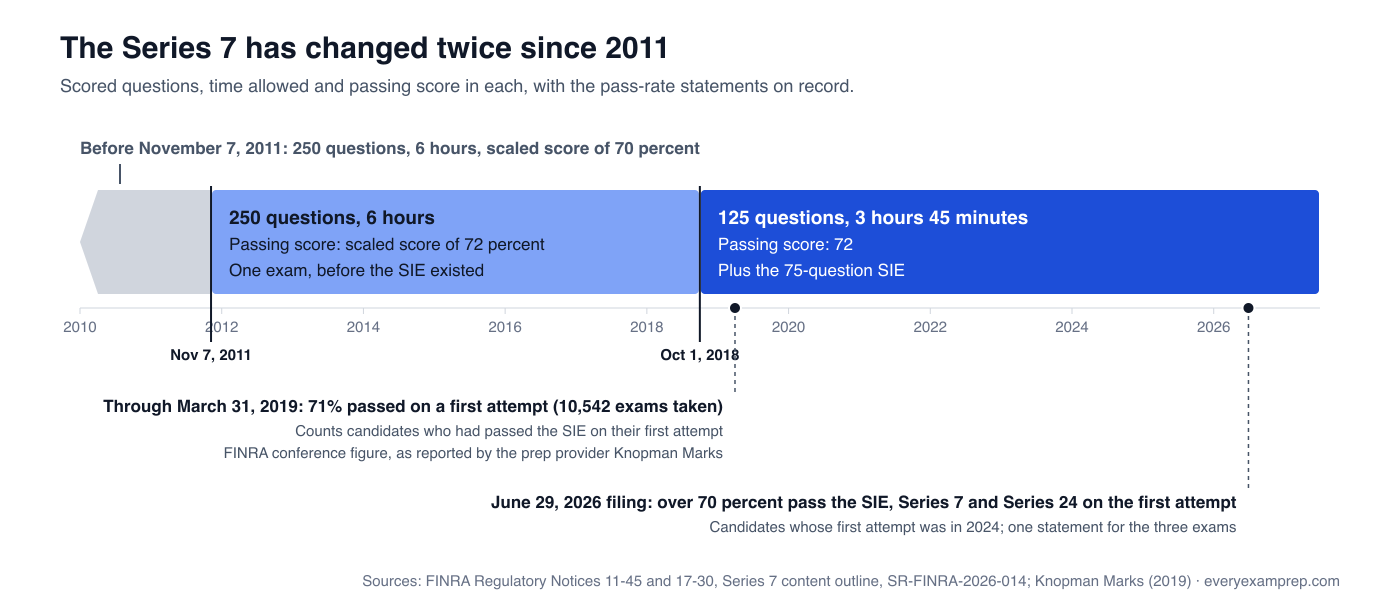
A pass rate belongs to the exam of its day. Regulatory Notice 11-45 (September 2011) raised the mark on the 250-question exam from November 7, 2011. Regulatory Notice 17-30 (October 2017) replaced that exam on October 1, 2018 with the SIE and a shorter Series 7.
| Period | Scored questions | Time allowed | Passing score | FINRA source |
|---|---|---|---|---|
| Before November 7, 2011 | 250 | 6 hours | Scaled score of 70 percent | Regulatory Notice 11-45, describing the exam as it then stood |
| November 7, 2011 to September 30, 2018 | 250 | 6 hours | Scaled score of 72 percent | Regulatory Notice 11-45; Notice 17-30 confirms the 250 questions up to 2018 |
| Since October 1, 2018 | 125, plus the 75-question SIE as a separate exam | 3 hours and 45 minutes | 72 | Regulatory Notice 17-30 (questions); FINRA's Series 7 page (time and passing score) |
The six hours is the figure Notice 11-45 gave in 2011. A figure quoted for the Series 7 before October 1, 2018 describes a 250-question exam that no longer exists, sat by candidates who had no SIE to pass. Today FINRA's Series 7 page says candidates "must pass both the Series 7 exam and the SIE exam" to obtain the General Securities registration.
What the passing score of 72 measures
FINRA's Series 7 page lists the passing score as 72. In a filing made on September 27, 2018 (SR-FINRA-2018-036), FINRA described how it arrives at such a number: by "a process known as standard setting, which assesses a number of factors, including industry trends, historical examination performance and evaluations of content difficulty by a committee of industry professionals who have passed the related examination". The result "reflects the minimum level of knowledge necessary to perform the functions for which a candidate is registering". That description sets a level of knowledge to reach. It mentions no quota and no fixed share of candidates who may pass.
The 72 is also not a count of questions. Other pages convert it: CertFuel writes that "you need 90 of 125 scored questions correct", and AB Training Center "at least 90 questions correctly". The arithmetic holds, since 72% of 125 is 90, but the FINRA pages we read give no number of questions. The content outline says all candidate test scores "are placed on a common scale using a statistical adjustment process known as equating", so that "every candidate is held to the same passing standard regardless of which set of exam items they received". FINRA's test-center page adds that in some cases "the results report will indicate that the score provided is an equated score". The idea is not new: Regulatory Notice 11-45 called the 2011 mark a "scaled score" that "accounts for these slight variations" in difficulty between exams.
So a candidate's score reaches the 72 after equating, not by a raw count. We found no FINRA table that converts the 72 into correct answers. It follows from FINRA's description of equating, though FINRA does not say it in these words, that the count need not be the same on every set of questions.
Two more details from the content outline bear on the score. Each exam carries 5 unscored pretest questions among its 130; they are unidentified and "randomly distributed throughout the exam". And the 125 scored questions are not spread evenly across the outline's four job functions: one function, on investment information, recommendations, asset transfers and records, holds 91 of them, which is 72.8%. The other three hold 9, 11 and 14, or 34 together (27.2%). The table of all four is on our Series 7 exam page.
What you are told after the exam
FINRA's test-center page says results appear "on the computer screen shortly after you complete your exam", with a printed copy of the pass/fail results report. What the report shows depends on the result:
- Pass: "no additional scoring details will be provided".
- Fail: "your overall exam score and your performance on each of the topic sections on the exam".
That split dates from 2018. In its September 27, 2018 filing FINRA wrote that "starting on October 1, 2018, FINRA will no longer provide a total score and a score profile for each major section of the content outline to candidates who pass a qualification examination", and that it would keep providing both to a candidate who fails. Its stated reason: "FINRA believes that providing such information is unnecessary once a candidate has met the minimum score threshold for passing an examination." The filing adds that FINRA exams "are not designed to provide information beyond demonstration of basic proficiency".
One consequence for anyone reading about pass marks online: under that policy a candidate who passes gets no score, so a "typical passing score" for the current exam cannot come from results reports.
Reading practice scores against the 72
Because FINRA equates scores, a practice percentage does not convert to the 72. Our free Series 7 practice test has 200 original questions and breaks your accuracy down by topic. Its seven categories are ours, not FINRA's four functions. The Series 7 study guide sets out what each function covers, and the Series 7 cheat sheet is the one-page review. Who can sit the exam is in our Series 7 requirements guide, and the corequisite exam's figures are in our article on the SIE pass rate.
Free Series 7 practice test — 200 questions, instant feedback. No signup required.
Sources
- 1.SEC — Release No. 34-105885, File No. SR-FINRA-2026-014: FINRA's filing to amend Rule 1210 (91 FR 43678, July 16, 2026) — FINRA (rule filing, published by the SEC) (accessed Nov 15, 2026)
- 2.FINRA — Series 7: General Securities Representative Exam — FINRA (accessed Nov 15, 2026)
- 3.FINRA — General Securities Representative Qualification Examination (Series 7) Content Outline — FINRA (accessed Nov 15, 2026)
- 4.FINRA — Prepare for Your Test Center Appointment — FINRA (accessed Nov 15, 2026)
- 5.SEC — Release No. 34-84376, File No. SR-FINRA-2018-036: test result information for candidates who pass (83 FR 51720, October 12, 2018) — FINRA (rule filing, published by the SEC) (accessed Nov 15, 2026)
- 6.FINRA — Regulatory Notice 11-45: FINRA Revises the Series 7, 17, 37 and 38 Examination Programs (September 2011) — FINRA (accessed Nov 15, 2026)
- 7.FINRA — Regulatory Notice 17-30: Restructured Representative-Level Qualification Examinations (October 2017) — FINRA (accessed Nov 15, 2026)
- 8.Knopman Marks (prep provider) — FINRA Conference Report: SIE and Securities Exam Statistics (May 22, 2019) — Knopman Marks (secondhand report of FINRA figures) (accessed Nov 15, 2026)
Frequently asked questions
What is the Series 7 pass rate?
FINRA's Series 7 page and content outline give no pass rate, and we found no FINRA page that reports one regularly. In a rule filing dated June 29, 2026, FINRA said that over 70 percent of candidates pass the SIE, the Series 7 and the Series 24 on the first attempt, based on first attempts in 2024; that is one statement for the three exams. The only Series 7 figure is 71% for the exam's first six months, to March 31, 2019, as the prep provider Knopman Marks reported it from FINRA's 2019 Annual Conference.
What is the Series 7 failure rate?
We found no failure rate published by FINRA. Its June 29, 2026 filing says over 70 percent pass the SIE, the Series 7 and the Series 24 on the first attempt, so by subtraction fewer than 30 in 100 of those candidates fail on the first attempt, across the three exams. The same filing reports that 85 percent of candidates who fail the Series 7 take it a second time.
How many people pass the Series 7 exam?
We found no count of passes on FINRA's pages. On record are a share (over 70 percent passing the SIE, the Series 7 and the Series 24 on the first attempt, in FINRA's 2026 filing) and counts of exams taken. The counts are from Knopman Marks' reports of FINRA's 2019 conference presentations: 10,542 Series 7 exams taken between October 1, 2018 and March 31, 2019, and 24,675 by August 31, 2019. FINRA's 2026 filing calls the Series 7 one of its three most popular qualification examinations.
What score do you need to pass the Series 7?
FINRA lists the passing score as 72. Its content outline says all scores are placed on a common scale by equating, and the FINRA pages we read give the 72 with no number of questions. By arithmetic, 72% of the 125 scored questions is 90, but FINRA states no such count on those pages.
Is the Series 7 graded on a curve?
FINRA describes no curve. In its September 27, 2018 filing it said passing scores are set by standard setting, which weighs industry trends, historical examination performance and a committee's evaluation of content difficulty, and reflect the minimum level of knowledge needed for the job. Its content outline says equating holds every candidate to the same passing standard regardless of which questions they received.
Do you get your score on the Series 7?
Only if you fail. FINRA's test-center page says a pass result comes with no additional scoring details, while a fail result shows your overall exam score and your performance on each topic section. FINRA's September 27, 2018 filing ended scores for passing candidates from October 1, 2018.