Prepare for Claude Certified Associate – Foundations by building a workflow you can explain and checking the outputs it produces. This 14-day plan pairs Anthropic’s free prep course with original workplace exercises, a weighted practice budget, and a timed review. It is for people who already use Claude at work and need a concrete sequence for turning that familiarity into exam preparation.
The calendar is our suggested schedule, not an Anthropic requirement or a promise that two weeks is enough. Extend the exercises you cannot complete independently. For the full syllabus, use our Claude Associate study guide; this article focuses on what to do each day and what evidence to keep.
Before you start: check access and choose a safe project
Anthropic’s certification FAQ limits exam registration to people at Claude Partner Network organizations using a recognized company email domain. A personal account or a completed course does not establish exam eligibility. The CCAO-F exam guide separately says there are no mandatory prerequisite courses or API-development requirements. Those statements address different things: registration access and prior learning.
Use a fictional service team as your practice project. Create a short service policy, several invented support requests, and a manager’s reporting brief. Give the policy a version date and include at least one question it cannot answer. These files let you practise prompting, verification, escalation, and updating knowledge without uploading customer records. If your organization permits a real internal project, follow its data rules before adding any files.
This is our original training scenario, not an official exam question. The goal is to finish with a small collection of inspectable work: a prompt, a checked response, a workflow diagram, an updated knowledge file, and an error log.
What deserves the most practice time?
Anthropic’s exam blueprint, section 6, assigns the largest weight to output evaluation. Prompt writing is only one domain. Use the weights as a starting point, then move time toward the mistakes your exercises expose.
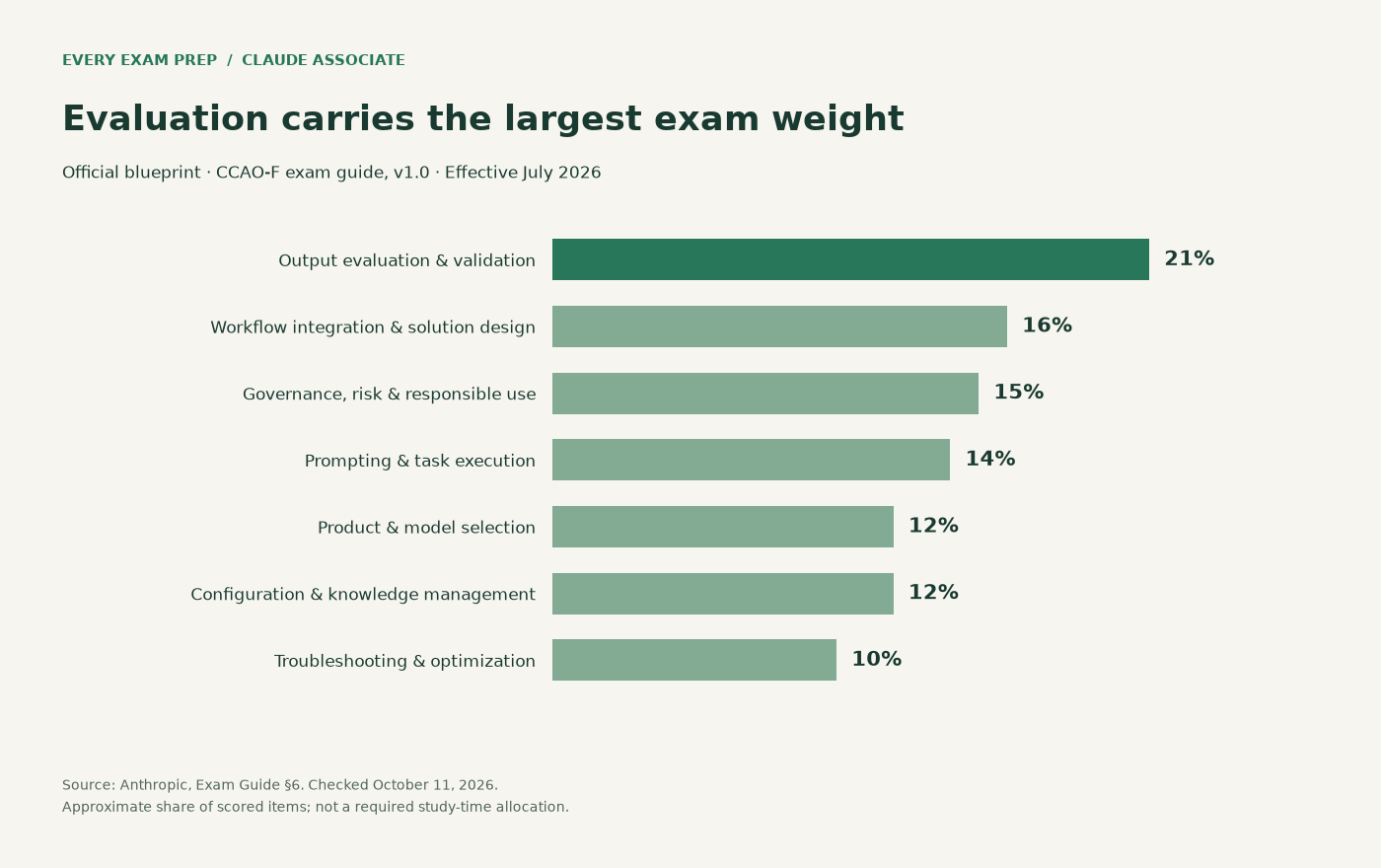
For an example budget of 10 hours of active practice, our calculation is 600 minutes × each domain’s weight. That assigns 126 minutes to evaluation and 84 to prompting. This is a transparent starting allocation, not a validated predictor of exam success. It also avoids treating the smallest domain as optional.
| Domain | Official weight | Our practice minutes | Evidence to keep |
|---|---|---|---|
| Output Evaluation and Validation | 21% | 126 | A claim-check table with unresolved claims marked |
| Workflow Integration and Solution Design | 16% | 96 | A process map with an owner for each approval |
| Governance, Risk, and Responsible Use | 15% | 90 | A data-use decision and escalation rule |
| Prompting and Task Execution | 14% | 84 | A prompt revision that addresses a named defect |
| Product and Model Selection | 12% | 72 | A feature/model choice with task-specific reasons |
| Configuration and Knowledge Management | 12% | 72 | A versioned knowledge file and retest notes |
| Troubleshooting and Optimization | 10% | 60 | A root-cause hypothesis and a controlled retest |
| Total | 100% | 600 | Original practice work, not an exam score |
The 14-day study plan
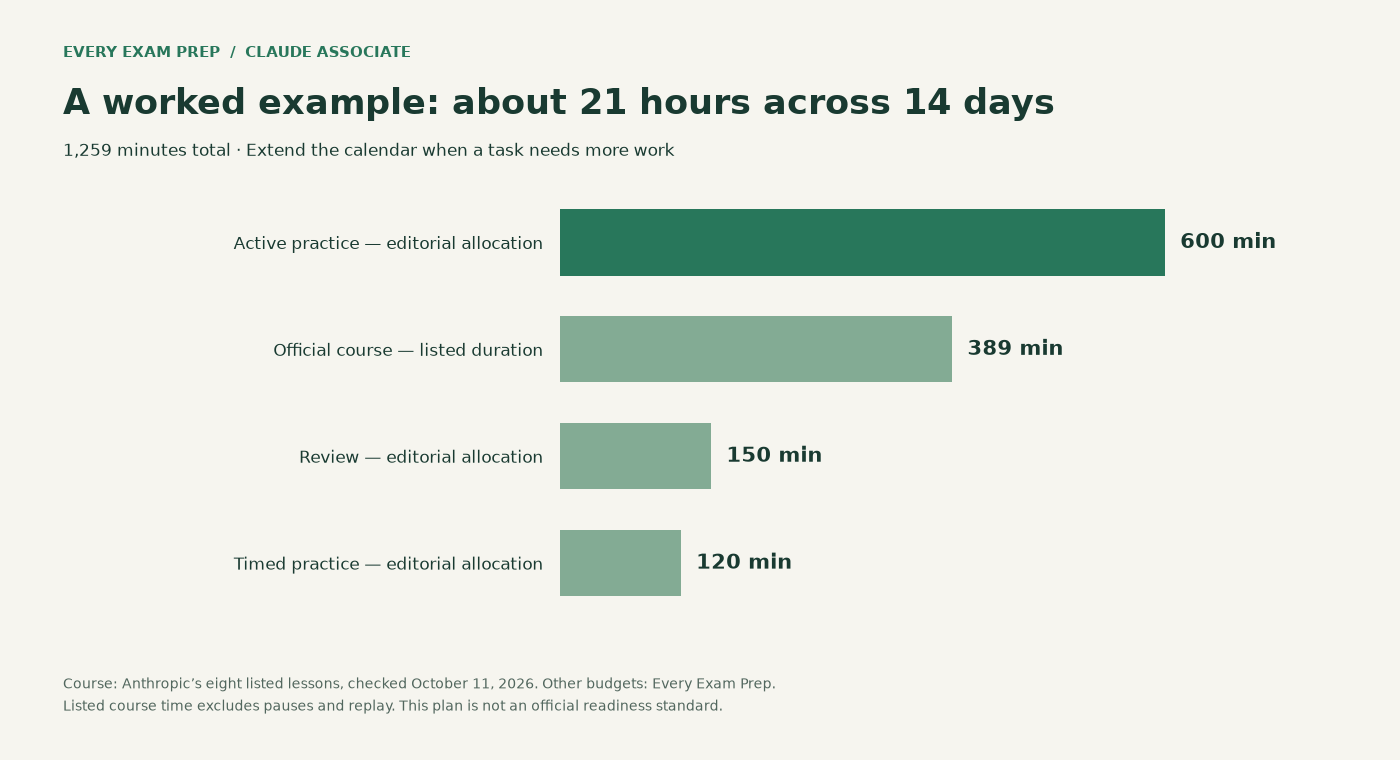
Anthropic’s free Associate prep course lists eight lessons lasting 59, 53, 74, 63, 47, 55, 30 and 8 minutes. We total those listings at 389 minutes: 6 hours 29 minutes. That is listed lesson time, not a measured completion time; pauses, exercises and replay can take longer.
Our calendar adds the 600-minute practice budget, a 120-minute timed block and 150 minutes for review: 1,259 minutes, or about 21 hours. The uneven days are intentional. If a long session will not fit, split it and extend the calendar; keep the work product, rather than the date, as your completion rule.
| Day | Work | Minutes | Finish with |
|---|---|---|---|
| 1 | Platform/model lesson + selection exercise | 59 + 72 = 131 | A choice memo for the fictional support task |
| 2 | Prompting lesson + prompt revision | 53 + 84 = 137 | An initial prompt, a failed case and a targeted revision |
| 3 | Evaluation lesson + first claim audit | 74 + 63 = 137 | A table connecting each answer claim to the policy |
| 4 | Second evaluation exercise | 63 | An answer that handles missing information explicitly |
| 5 | Workflow lesson + process design | 63 + 48 = 111 | A request-to-approval process map |
| 6 | Workflow exception exercise | 48 | A human handoff for an unsupported policy exception |
| 7 | Configuration lesson + knowledge update | 47 + 72 = 119 | A revised policy file and a retested answer |
| 8 | Governance lesson + data-use exercise | 55 + 90 = 145 | A decision about which inputs may be used and why |
| 9 | Troubleshooting lesson + controlled retest | 30 + 60 = 90 | A defect, suspected cause, single change and result |
| 10 | Course summary + error-log review | 8 + 30 = 38 | A list of gaps grouped by exam domain |
| 11 | Repair the highest-priority gap | 40 | A new example solved without copying your earlier answer |
| 12 | Mixed review and official sample rationales | 40 | An explanation for each rejected option |
| 13 | Timed, closed-resource practice | 120 | A timing record and mistakes saved for later review |
| 14 | Review mistakes and decide what needs more work | 40 | A targeted extension plan, if needed |
What to do in the exercises
Make a choice you can defend
For day 1, compare the needs of a one-off reply with a recurring team workflow. Write down the relevant context, desired output, and tradeoff between speed and reasoning. Select the features and model available in your approved environment, then explain why they fit. Do not memorise a model-version ranking: the guide tests choosing for the task.
Repair the cause of a bad response
For day 2, ask for a reply using only the fictional policy. Require the answer to separate what the policy supports from what needs a manager’s decision. If the response invents a refund exception, revise the instruction that controls unsupported exceptions. Simply asking for a more confident or more polished answer does not address that defect.
Audit claims, including the ones that sound plausible
On days 3 and 4, use this deliberately flawed draft: “We will deliver the replacement tomorrow and reimburse your shipping.” In the fictional policy, replacements require approval and shipping reimbursement is not addressed. The first claim promises an outcome before approval; the second fills a gap with an invented commitment. Rewrite the response to explain the approval step and identify the unanswered reimbursement question.
| Draft claim | Evidence in the fictional policy | Decision |
|---|---|---|
| Replacement will arrive tomorrow | Approval required; no delivery promise supplied | Remove the promise; explain the next approval step |
| Shipping will be reimbursed | The policy is silent | Mark unresolved and ask the responsible person |
| The reply needs manager approval | The approval requirement is explicit | Keep, and point to the applicable policy section |
The point is to evaluate the claim against evidence outside the generated answer. Claude’s explanation of why its own answer is correct is another output to check.
Make the human handoff explicit
For days 5 and 6, map the support workflow: receive a request, locate the current policy, draft a reply, review unsupported commitments, approve, then send. Assign responsibility to the human or tool at each step. Introduce an exception the policy does not cover. Your design should show who receives it and what context they need, without allowing a draft to approve itself.
Update knowledge and test the change
For day 7, change a detail in the fictional policy. Record its new version, replace the superseded file in the practice Project, and repeat the earlier request. Compare the response with the current policy. If it still uses the old detail, investigate remaining context and conflicting instructions before assuming that a more expensive model will fix it.
Separate permission from technical capability
For day 8, imagine that the support requests contain account identifiers. Decide whether the proposed upload is permitted by the fictional organization’s policy, what information the task actually needs, and when approval is required. Removing a name alone does not establish that a file is safe to upload. In a real organization, follow the applicable policy and ask the responsible team when it is unclear.
Retest one change at a time
For day 9, choose one recurring failure: an omitted constraint, stale policy detail or unsupported promise. Write a cause you can test, change one relevant instruction or input, and run a new example. Keep the before-and-after responses. That record distinguishes a repair from a lucky answer.
How to adjust the plan after mistakes
Use days 10–12 to redirect attention. Record the domain, your decision, the evidence you missed, and the next task that would test the same skill. A mistake about disclosure belongs in governance even if it appeared inside a prompting exercise.
For example, if your prompt produces the requested format but repeatedly makes unsupported commitments, spend the next review block auditing claims, rather than polishing formatting again. If you can spot the error but cannot decide who should approve an exception, practise the workflow handoff. These are editorial troubleshooting suggestions, not score calculations.
Use our free Claude Associate practice questions for additional original exercises. They are independent study material, not Anthropic’s exam bank. Keep an error log instead of treating a repeated question’s correct answer as evidence that you can handle a new scenario.
Timed practice: useful rehearsal, not a pass prediction
Anthropic’s exam guide, section 5, lists 60 multiple-choice or multiple-response items in 120 minutes and a passing scaled score of 720 on a 100–1,000 scale. Dividing the time by the item count gives a two-minute average pacing budget; individual questions can take different amounts of time. Do not read 720 as 72% correct or use a practice percentage as its equivalent.
For day 13, assemble an unseen set covering the domains before starting the timer. If you do not have enough fresh questions for a full-length session, use a shorter set and record that limitation; do not label repeated questions a full mock exam. Choose answers before reading explanations, and leave review until the timed block ends.
Anthropic’s FAQ says the exams are closed book and its former practice exam was retired in the move to Pearson VUE. Anthropic’s Exam Policy also prohibits AI assistance during the exam. Rehearse without notes or Claude assistance. Use the sample questions linked in the official guide to understand the style and rationale; this article does not reproduce them or claim to reproduce the live exam.
On day 14, check whether you can explain your choices on fresh tasks, validate unsupported claims, and identify a human escalation when needed. If a skill still depends on copying an example, extend that part of the plan. Finishing the calendar is not an official readiness threshold.
Who wrote this and how to use it
By the Every Exam Prep Editorial Team. We checked Anthropic’s exam guide, certification FAQ, course listing, certification directory and Exam Policy on October 11, 2026. The guide is version 1.0, effective July 2026. The domain weights and course durations come from those documents; the minute allocations, fictional support scenario, worksheets and calendar are our editorial work.
We do not claim to have taken this exam or measured a pass rate for this plan. Every Exam Prep is an independent preparation site, not Anthropic or Pearson VUE. Our editorial policy describes source checks and AI assistance. Send a source correction through our contact page. For registration details, use the Claude Certified Associate exam overview.
Free Claude Certified Associate practice test — 150 questions, instant feedback. No signup required.
Sources
- 1.Claude Certified Associate – Foundations Exam Guide, v1.0 (July 2026) — Anthropic (accessed Oct 11, 2026)
- 2.Claude Certified Associate – Foundations Prep Course — Anthropic (accessed Oct 11, 2026)
- 3.Certification FAQ — Anthropic (accessed Oct 11, 2026)
- 4.Claude certification directory — Anthropic (accessed Oct 11, 2026)
- 5.Anthropic Certification Exam Policy — Anthropic (accessed Oct 11, 2026)
Frequently asked questions
Can I prepare for Claude Certified Associate in two weeks?
This is a two-week example for someone already using Claude at work, not a promise of readiness. It contains about 21 hours of listed lessons and planned exercises. Extend the work you cannot complete independently; Anthropic’s exam guide does not prescribe a required study period.
Is the official preparation course free?
Anthropic labels its Associate prep course free. That is separate from exam registration and eligibility. The certification FAQ restricts exam access to people at Claude Partner Network organizations using a recognized company email.
What should I practise first?
Start with a task and tool choice, then create outputs you can evaluate. Anthropic’s blueprint gives output evaluation the largest weight, 21%. Our plan allocates 126 of 600 active-practice minutes to that domain, with later review redirected by your mistakes.
Does 72% on a practice test mean I would pass?
No. Anthropic’s guide sets a passing scaled score of 720 on a 100–1,000 scale. A raw percentage from an independent practice set cannot be treated as that score or a pass prediction.