Why Exam Prep Needs an Evidence Trail, Not Just More Questions
How Every Exam Prep turns official exam documents into source-linked guides, original practice questions, and a clearer way to prepare.

The hardest part of preparing for a professional exam is often not learning the material. It is deciding which information deserves your trust. Search for an exam fee, a retake policy, or even the number of questions on a test, and you can find several confident answers within minutes. The problem is that they may refer to different exam versions, jurisdictions, or policies that changed months ago.
That confusion has a real cost. A candidate may buy the wrong course, study an outdated objective, miss an application step, or spend hours memorizing questions that never build the underlying skill. More content does not automatically solve the problem. Sometimes it simply multiplies the uncertainty.
Why I built Every Exam Prep
I did not start Every Exam Prep because the internet needed another giant pile of questions. I started it because, after preparing for exam after exam myself, I kept running into the same avoidable confusion.
Over the years, I prepared for and passed the Life Insurance licensing exam, the Special Enrollment Examination leading to Enrolled Agent status, the SIE, Series 6, Series 63, Series 65, and the CFP® examination. These tests cover very different material. Yet the preparation experience often felt surprisingly similar: one browser tab held the official outline, another held a regulator or sponsor page, a third held a course summary, and my own notes tried to reconcile the differences.
The official documents were authoritative, but they were not always written around the questions a candidate asks at 11 p.m.: What changed? Which rule applies to me? Is this fee the exam fee or the total licensing cost? Why is my answer wrong? What should I study next? Commercial resources could be convenient, but a polished explanation did not always reveal when the underlying rule had last been checked.
So I developed a routine. I began with the current outline. I turned the official material into a compact fact sheet. I wrote or used practice questions to expose gaps, recorded mistakes by domain, and returned to the source whenever an explanation felt uncertain. With more than 20 years of software-engineering experience, my instinct was to make that process repeatable instead of rebuilding it before every exam. That personal system became the idea for Every Exam Prep.
| Exam experience | What repeatedly became clear during preparation |
|---|---|
| Life Insurance licensing | Jurisdiction, policy language, and current rules matter more than a generic summary. |
| EA / federal tax | A precise answer needs a dated primary source and a clearly defined tax year or fact pattern. |
| SIE, Series 6, 63 and 65 | Similar-sounding exams can lead to different registrations, roles, and study priorities. |
| CFP® examination | Knowing isolated facts is not enough; candidates must connect concepts and explain decisions. |
The internet has no shortage of exam content
Candidates can now choose from enormous question banks, downloadable cheat sheets, short videos, AI-generated summaries, private groups, and pages that promise a fast route to a passing score. Some of those resources are useful. Others are optimized for volume rather than understanding.
A large question count is easy to advertise. It is much harder to maintain current exam coverage, explain why an answer is correct, identify where a rule came from, and say when a claim no longer applies. The same is true of pass rates, salaries, costs, and licensing requirements. A precise-looking number without a source, date, population, and scope may be less useful than an honest range with clear limitations.
There is another problem: recalled or so-called “real exam” questions. They can violate exam rules, expose learners to unreliable material, and reward memorization without comprehension. Good practice questions should test the same knowledge and reasoning as the exam while remaining original—not pretend to reproduce confidential live items.
What changes when a study resource has an evidence trail
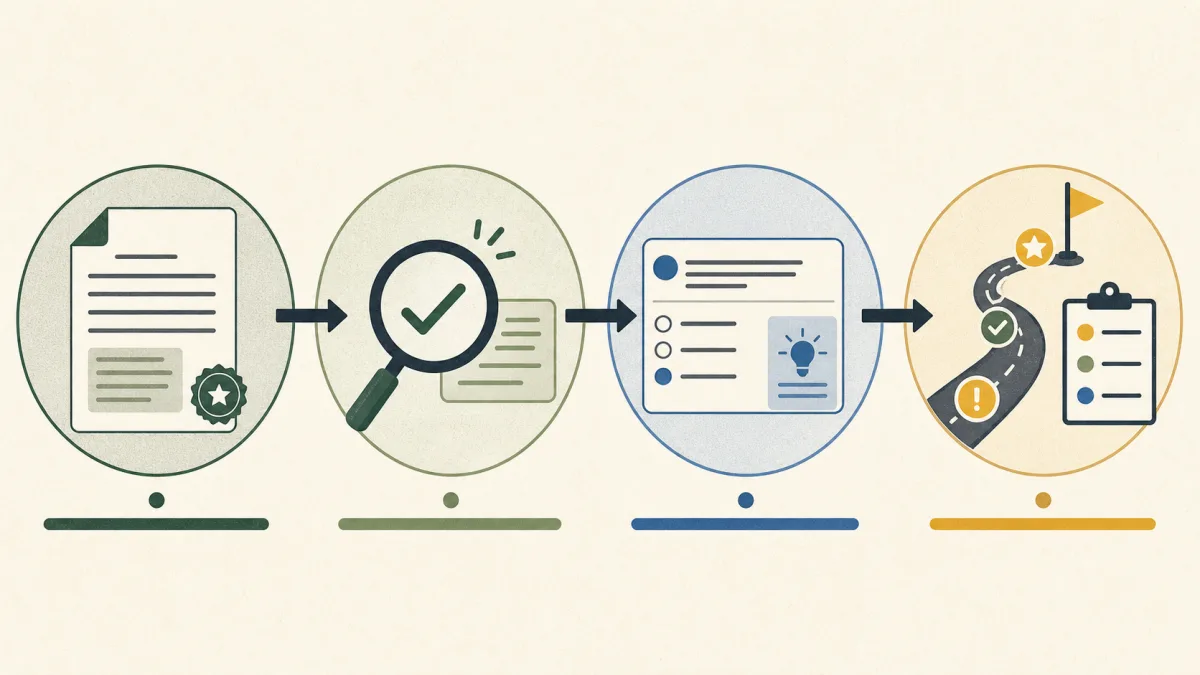
An evidence trail does not make a page perfect. It makes the page inspectable. A learner can see the source, understand the scope, and make a better decision when official guidance changes. In practice, that means four connected steps.
- Start with the authority. The exam sponsor, regulator, state agency, or official candidate handbook should anchor claims about eligibility, cost, format, scoring, and content domains.
- Turn documents into bounded facts. A fact needs context: the version or jurisdiction it applies to, the date it was reviewed, and any condition that changes the answer.
- Build original learning material. Questions and explanations should assess the official objectives without copying or claiming access to live exam items.
- Convert evidence into action. The learner ultimately needs a plan: what to study first, where weaknesses appear, and which official step comes next.
What that personal method became
Every Exam Prep is the free study platform I wished I had while moving from one exam to the next. Today, our editorial team organizes practice tests, study guides, cheat sheets, exam explainers, and planning resources across certification and licensing paths in finance, information technology, healthcare, project management, food safety, and other fields.
The category list is broad, but the publishing standard should be narrow: a page must earn its place by helping a candidate answer a real question. That may mean explaining the difference between an exam sponsor’s eligibility rule and a state licensing requirement. It may mean breaking a fee into application, examination, fingerprinting, and renewal components instead of presenting one misleading total. It may mean showing which content domain a practice question covers and why the distractors are wrong.
My own subject-matter review is limited to the areas I can substantiate—finance, securities, insurance, federal tax practice, and financial-planning certification. For other fields, we label the work as editorial or technical source review rather than implying a license or professional background I do not hold. That distinction matters: transparency about who checked a page is more credible than attaching one broad “expert reviewed” badge to everything.
| Content-first shortcut | Evidence-first preparation |
|---|---|
| Publish the biggest question bank | Map questions to the current official outline |
| Repeat a number found on another blog | Bind dates, fees, and rules to primary sources |
| Optimize one answer for every learner | State jurisdiction, version, role, and limitations |
| Treat confidence as proof | Show what was checked, when, and against what |
You can see the rules we apply in our editorial policy and the limits of each reviewer’s role on our team page.
A concrete example: preparing for the Series 7
Consider a learner preparing for the Series 7. A weak approach begins with a random bank of securities questions and counts how many answers the learner gets right. An evidence-first approach starts with the current FINRA outline and asks a different set of questions: Which job functions carry the most weight? What decisions must a registered representative be able to make? Which errors reveal a missing concept rather than a careless click?
From there, original practice can be organized by objective. An explanation should do more than reveal the correct letter. It should show the rule or reasoning, explain why a plausible distractor fails, and point the learner toward the underlying concept. Performance by domain then becomes a roadmap: a candidate who repeatedly misses suitability questions needs a different intervention from one who struggles with options calculations.
For the authoritative starting point, see FINRA’s Series 7 exam page and content outline. The source is not decoration; it defines what the study material must cover.
When you are ready to test that understanding, use our free Series 7 practice test and review errors by objective rather than memorizing answer letters.
The same method works for very different exams
The evidence changes by subject, but the discipline stays the same. A New York notary candidate needs the current state rules and application process, not a generic nationwide summary. A PMP candidate needs the applicable PMI exam content outline and current exam information. A food-handler candidate needs material scoped to the correct program and jurisdiction rather than questions borrowed from unrelated healthcare or workplace-safety banks.
Authoritative starting points include the New York Department of State Notary Public page and PMI’s PMP certification and exam information. Each exam sponsor’s current candidate handbook or outline should remain the final authority. These source links were checked on August 23, 2026.
Our own navigation follows the same idea: start with the exam you actually plan to take, then choose the practice test, study guide, or cheat sheet built for that scope.
How to evaluate any exam-prep page in five minutes
You do not need to audit every sentence before using a resource. A short inspection can reveal whether a page is helping you reason or merely asking for trust.
- Source: Does the page link to the exam sponsor, regulator, or official handbook for factual claims?
- Scope: Does it name the exam version, state, role, or audience to which the information applies?
- Date: Can you tell when the source and page were last reviewed?
- Originality: Are practice questions described as original, or does the page imply access to confidential live items?
- Explanation: Do answers teach the rule and address plausible mistakes, or only mark right and wrong?
- Limits: Does the article say what it cannot establish—for example, local fees, unpublished pass rates, or employer-specific requirements?
- Next step: Does it direct you to the official application, outline, or study action that follows?
What we will not promise
No study site can guarantee that a reader will pass. Exam performance depends on prior knowledge, study time, test-day conditions, and the version of the exam a candidate receives. We also do not claim that our original practice questions are recalled live exam items. They are study tools designed around published objectives.
We also do not want a static article to become a substitute for the authority that governs the exam. When official sources conflict with a summary, the official source wins. When a fee varies by jurisdiction or a pass rate is not publicly released, the honest answer is to state that limitation rather than manufacture certainty.
That may sound less dramatic than a “pass fast” promise. It is also more useful. Candidates deserve to know which facts are stable, which require confirmation, and which study tasks are worth their limited time.
A better relationship with exam prep
The best study resource is not the one that asks you to stay inside it. It is the one that helps you understand the exam, identify a gap, practice deliberately, and move to the next reliable source or action. Our goal for Every Exam Prep is to make that path easier to see.
We are continuing to review existing material, hold back or remove pages that cannot support their claims, strengthen citations, separate requirements by jurisdiction, and improve original explanations and visual guides. This work is slower than publishing pages at scale—and that is the point. Trust is built through visible editorial choices, not a badge placed beside a headline.
Explore the free resources from the exam directory. If you spot an outdated source, an unclear explanation, or a factual error, write to contact@everyexamprep.com. Corrections are part of the evidence trail too.