In this article · 8 sections
To become a notary public in New York, you must be at least 18 and live in New York or have an office or business there. You pass a $15 state exam, get an Oath of Office form notarized, and apply online through NY Business Express with a $60 fee. That is $75 in state fees. NY Business Express lists an average processing time of 3 to 5 business days, and a commission lasts four years. Unlike some states, the Department lists no pre-exam course, no bond and no fingerprinting step.
This guide follows the Department of State's own pages: its Become a Notary Public page, its notary FAQ and the NY Business Express listing for the commission. We also counted the state's public list of every active notary, which shows where New York's 223,189 commissions are. For the exam itself, see our New York notary exam guide and the free New York notary practice test.
Who can become a notary in New York
You need to meet these requirements:
- Age: 18 or older.
- Where you live or work: a New York resident, or someone with an office or place of business in New York. So you can live in New Jersey or Connecticut and still qualify if you have an office or place of business in New York, such as where you work.
- Character and education: good moral character, the equivalent of a common school education, and familiarity with what a notary does.
- The exam: pass the state notary exam. New York attorneys and qualifying court clerks of the Unified Court System skip it, but they still pay the application fee.
A criminal record. The Department's FAQ says a felony conviction generally bars you, and certain misdemeanors also disqualify. That is not always the end. If you have an executive pardon, a certificate of relief from disabilities, or a certificate of good conduct from the parole board, the Department may consider you.
The five steps
| Step | What you do | Cost |
|---|---|---|
| 1. Check you qualify | Age, residence or workplace, and any record, as above | Free |
| 2. Pass the exam | One hour, multiple choice, graded pass or fail | $15 |
| 3. Notarize your Oath of Office | Fill in form DOS-2201, sign it in front of a notary, scan it to PDF | Up to $2 in person, or free at your county clerk's office |
| 4. Apply online | NY Business Express: pick traditional or electronic, upload the oath, pay | $60 |
| 5. Get your ID card and start | Print the ID card you get by email, buy a journal, and keep records | A journal |
Step 2: pass the exam
The Department of State charges $15 for the exam. Its exam information sheet says the test is multiple choice and you get one hour. The questions cover notary law and the terms in the Department's Notary Public License Law booklet, so that booklet is your main study source. Bring a current government-issued photo ID with your signature on it, and two #2 pencils; none are provided. Besides English, the exam is offered in Spanish, Haitian-Creole, Italian, Korean, Russian and Chinese. If you have a learning, physical, mental or psychological disability, you can ask for special testing arrangements.
You won't get a score. Results come by mail as pass or fail, and the Department's FAQ says a result is valid for two years. Apply within that window, or you take the exam again.
The Department sets the exam dates and publishes them as schedule documents on its Become a Notary Public page. New York City has a schedule of its own: the current one covers November–December 2026 and comes with its own instructions. Our New York notary study guide walks through the booklet topic by topic.
Step 3: get your Oath of Office notarized
Before you start the online application, download the Notary Public Oath of Office form (DOS-2201), fill it in and sign it in front of a notary. Then scan it to a PDF. NY Business Express asks you to upload a notarized oath with every application, new or renewal.
In person, the Department's FAQ caps what a notary can charge you for this at $2; an electronic notary doing it online can charge up to $25. You may not have to pay at all. County Law §534 requires every county clerk's office to have at least one staff notary who notarizes documents for the public free of charge during business hours.
Step 4: apply on NY Business Express
Create a NY.gov account, or sign in, on NY Business Express. Click Apply for the type of commission you want, traditional or electronic (the next section helps you choose). Upload your oath and pay the $60 fee by MasterCard or Visa. Application fees are not refundable. (The Department also takes applications by mail, but online is how you get your ID card by email.)
Three tips that save time:
- Type carefully. NY Business Express names incorrect information as the common reason applications are denied. A denial can be appealed, but that costs you time.
- Don't mail a paper copy. The FAQ says extra papers can slow down an online application. Check your status on your NY Business Express dashboard instead.
- Think about which address you give. The address on your application can be released to anyone who asks under the Freedom of Information Law. If you don't want your home address shared, you can also give a New York business address for disclosure.
Step 5: your ID card, journal and stamp
Once you are approved, the Department's FAQ says you receive a printable ID card by email. If you live in New York, you are commissioned in your county of residence, and NY Business Express lists the term as four years.
Two things to know before your first notarization:
- You must keep a journal. The Department's FAQ says that since January 25, 2023, every New York notary has to record every notarial act. The Notary Public License Law booklet says to keep those records for at least ten years.
- A seal is optional, but your details are not. New York does not require a notary seal. Below your signature you print, type or stamp, in black ink, your name, the words "Notary Public State of New York", your county and your commission's expiration date. On papers that need an oath, add your commission number too. A rubber stamp with these lines saves you writing them out each time.
Per the Department's FAQ, you may charge up to $2 for an acknowledgment or an oath. Unless you are a lawyer, you may not give legal advice or draw up legal papers. And if you change your name during your term, keep notarizing under the name on your commission until you renew.
Traditional or electronic commission?
An electronic commission lets you notarize online, by live audio and video, as well as in person. You can apply for an electronic commission from the start. A traditional notary can also apply for one later, and it then replaces the traditional commission. Here is what changes, from the Department of State's FAQ:
| Traditional | Electronic | |
|---|---|---|
| Where the signer is | In front of you | In front of you, or online by audio and video |
| Most you can charge | $2 per act | $2 in person; up to $25 per electronic act |
| Records | Journal, kept 10 years | Journal, plus a recording of each online act, kept at least 10 years |
| Extra setup | None | A platform you choose that meets New York's standards, and, once you're commissioned, an exemplar of your electronic signature and seal |
A few rules to know first. During an electronic notarization, you must be physically in New York. The signer can be anywhere, though a signer outside the U.S. must confirm the document has a U.S. connection. The state does not certify platforms, so it is on you to pick one that meets New York's standards. And when your electronic license is issued, your traditional license is cancelled automatically. From then on you use the new electronic ID number on everything.
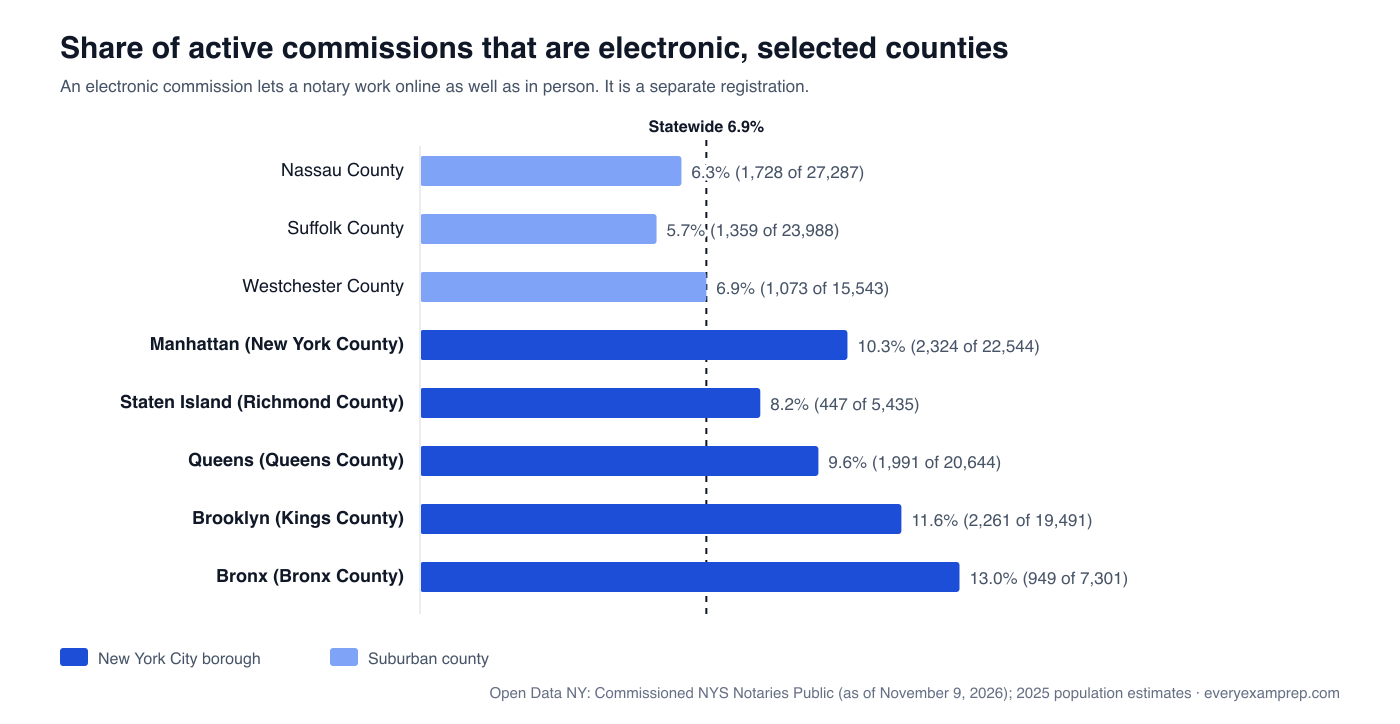
Few notaries hold an electronic commission. In the state's list of active notaries on Open Data NY, on November 9, 2026, 15,335 of New York's 223,189 active commissions were electronic, or 6.9%.
How to become a notary in NYC
The Department's steps are the same for every county, so there is no separate city license. New Yorkers in all five boroughs follow the steps above. The one thing that differs is your county name, because each borough is its own county: Manhattan is New York County, Brooklyn is Kings County, Staten Island is Richmond County, and the Bronx and Queens keep their names. That county goes next to your signature. To take the exam in the city, use the Department's New York City schedule.
The state's list, set against U.S. Census Bureau population estimates (as published by the New York State Department of Labor), shows the city is thinner on notaries than the rest of New York. The five boroughs have 8.8 active commissions per 1,000 residents, against 12.9 in the rest of the state (11.2 statewide). The Bronx has the fewest notaries per resident of any county: about one for every 193 people. Brooklyn has one for every 136.
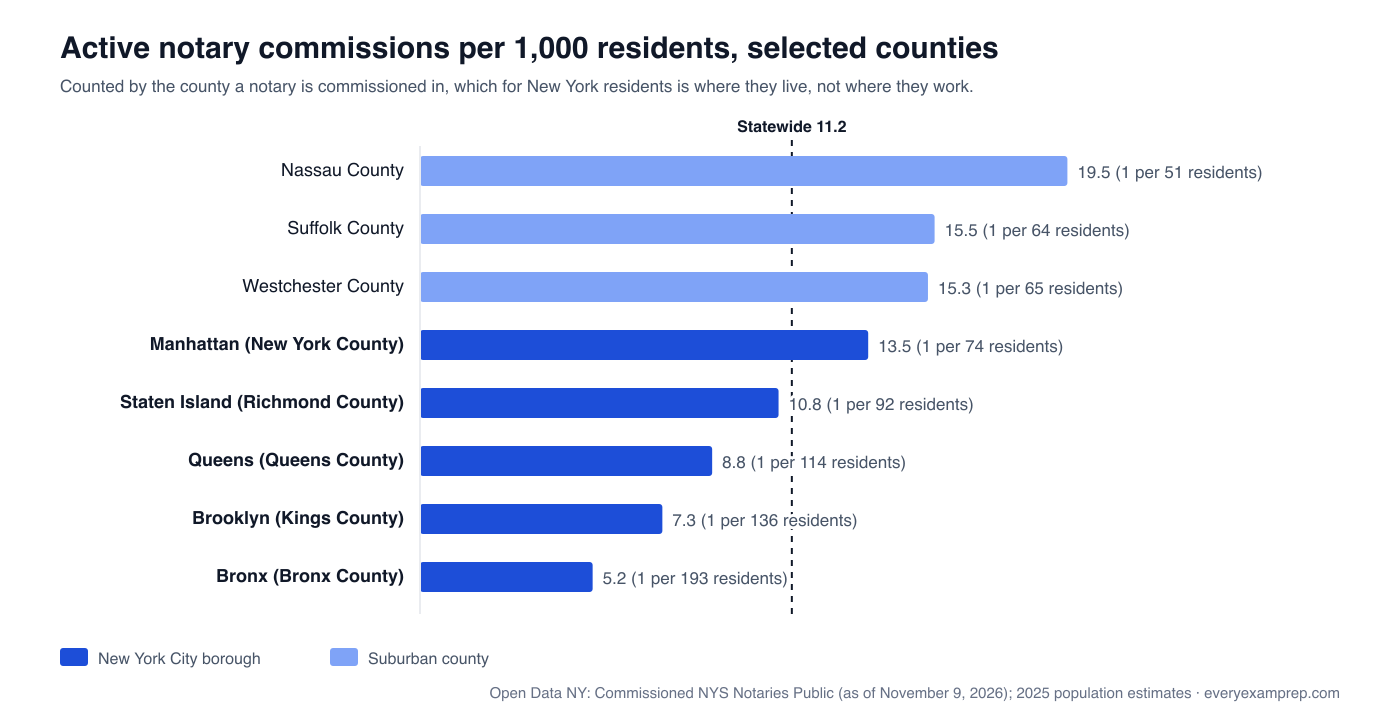
Part of the gap is how the list counts. New York residents are commissioned in the county where they live, not where they work. Someone who lives in Nassau County and works in Midtown counts as a Nassau notary. For New York residents, these numbers show where notaries live, not where they work.
City notaries are also more likely to hold an electronic commission. In every borough, a bigger share of commissions are electronic than the statewide 6.9%, from 8.2% in Staten Island to 13.0% in the Bronx.
| Borough | Active commissions | Residents per commission | Electronic |
|---|---|---|---|
| Manhattan (New York County) | 22,544 | 1 per 74 | 10.3% |
| Queens (Queens County) | 20,644 | 1 per 114 | 9.6% |
| Brooklyn (Kings County) | 19,491 | 1 per 136 | 11.6% |
| The Bronx (Bronx County) | 7,301 | 1 per 193 | 13.0% |
| Staten Island (Richmond County) | 5,435 | 1 per 92 | 8.2% |
Who holds New York's 223,189 commissions
The Department of State publishes its list of active notaries on Open Data NY. We counted it as of November 9, 2026, by county and by type, and matched each county to the Census Bureau's 2025 population estimate, which the state Department of Labor publishes on the same portal. We counted only totals; no names or addresses are used here.
Statewide, there is about one active commission for every 90 residents. Nassau County has the most, 27,287, more than Manhattan's 22,544. Long Island (Nassau and Suffolk) holds 23.0% of all commissions, and New York City 33.8%. Each commission on the list has a term start date. From November 2025 to October 2026, about 5,600 terms began a month, new commissions and renewals together.
| County | Active commissions | Per 1,000 residents | Electronic |
|---|---|---|---|
| Nassau | 27,287 | 19.5 | 6.3% |
| Suffolk | 23,988 | 15.5 | 5.7% |
| New York | 22,544 | 13.5 | 10.3% |
| Queens | 20,644 | 8.8 | 9.6% |
| Kings | 19,491 | 7.3 | 11.6% |
| Westchester | 15,543 | 15.3 | 6.9% |
| Erie | 10,421 | 11.0 | 3.9% |
| Monroe | 7,824 | 10.4 | 4.4% |
| Bronx | 7,301 | 5.2 | 13.0% |
| Richmond | 5,435 | 10.8 | 8.2% |
Keep three limits in mind. The list counts commissions, not how often anyone notarizes. A notary is counted in the county where they are commissioned, which for New York residents is where they live. And 1 record had no county, so it is in the statewide total but in no county row.
What it costs
| Item | Amount | Paid to |
|---|---|---|
| Written exam | $15 | Department of State |
| Commission application | $60 (not refundable) | Department of State |
| Notarizing your Oath of Office | Up to $2 in person (up to $25 online), or free from a county clerk's staff notary | The notary |
| Journal | Varies | Any supplier |
| Stamp (optional) | Varies | Any supplier |
| Online platform (electronic notaries only) | Varies | The platform you choose |
So the state's share is $75, or $60 if you are a lawyer or court clerk exempt from the exam. County clerk staff named as notaries pay no fees. The Department lists no bond or course.
How long it takes
The exam is the part with no set timeline. The Department says only that results come by mail as soon as they are ready. Once you apply, NY Business Express lists an average of 3 to 5 business days to process the application, and you get your ID card by email when it is approved.
Keeping your commission
NY Business Express lists a four-year term. The Department's renewal page says you can renew starting 90 days before your commission expires, and its fee list puts the renewal at $60. You need a new notarized Oath of Office each time. NY Business Express lists the written exam for original commissions, not renewals. Our New York notary exam guide covers renewal and what happens if your commission lapses.
Free New York Notary practice test — 150 questions, instant feedback. No signup required.
Sources
- 1.New York Department of State — Become a Notary Public — New York Department of State (accessed Nov 10, 2026)
- 2.New York Department of State — Notary Public Frequently Asked Questions — New York Department of State (accessed Nov 10, 2026)
- 3.NY Business Express — Notary Public Commission (DOS-0033) — New York Department of State (accessed Nov 10, 2026)
- 4.New York Department of State — Notary Public License Law — New York Department of State (accessed Nov 10, 2026)
- 5.Open Data NY — Commissioned NYS Notaries Public (as of November 9, 2026) — New York Department of State (accessed Nov 10, 2026)
- 6.Open Data NY — Annual Population Estimates for New York State and Counties (2025) — New York State Department of Labor (accessed Nov 10, 2026)
Frequently asked questions
How long does it take to become a notary in New York?
The exam has no set timeline: the Department says only that results come by mail as soon as they are ready. After that, NY Business Express lists an average of 3 to 5 business days to process your application, and your ID card comes by email once you are approved.
How much does it cost to become a notary in New York?
$75 in Department of State fees: $15 for the exam and $60 for the application. Add up to $2 (the in-person cap in the Department's FAQ) to notarize your Oath of Office, or nothing at a county clerk's staff notary, plus a journal. A stamp is optional, and the Department lists no bond or course.
Can I become a notary in New York with a criminal record?
A felony conviction generally bars you, and certain misdemeanors also disqualify. But the Department may consider you if you have an executive pardon, a certificate of relief from disabilities, or a certificate of good conduct from the parole board.
How do I become a notary in NYC?
The same way as anywhere in the state: pass the exam, get your Oath of Office notarized and apply on NY Business Express. There is no city license. If you live in the city, you are commissioned in your borough's county (Brooklyn is Kings County, Manhattan is New York County, Staten Island is Richmond County), and the Department posts a separate exam schedule for New York City.
Does New York require a notary stamp?
No, a seal is not required. But below your signature you must print, type or stamp in black ink your name, "Notary Public State of New York", your county and your commission's expiration date, plus your commission number on papers that need an oath. A rubber stamp saves writing it out.
Can New York notaries notarize online?
Yes, if they hold an electronic commission. An electronic commission is a notary commission that also covers online acts: you can apply for one directly, or switch to one later as a traditional notary. The Department of State's FAQ sets the rules: you must be physically in New York during each online act, and you must record it and keep the recording at least 10 years. You may charge up to $25 per electronic act. Your traditional license is cancelled when the electronic one is issued.