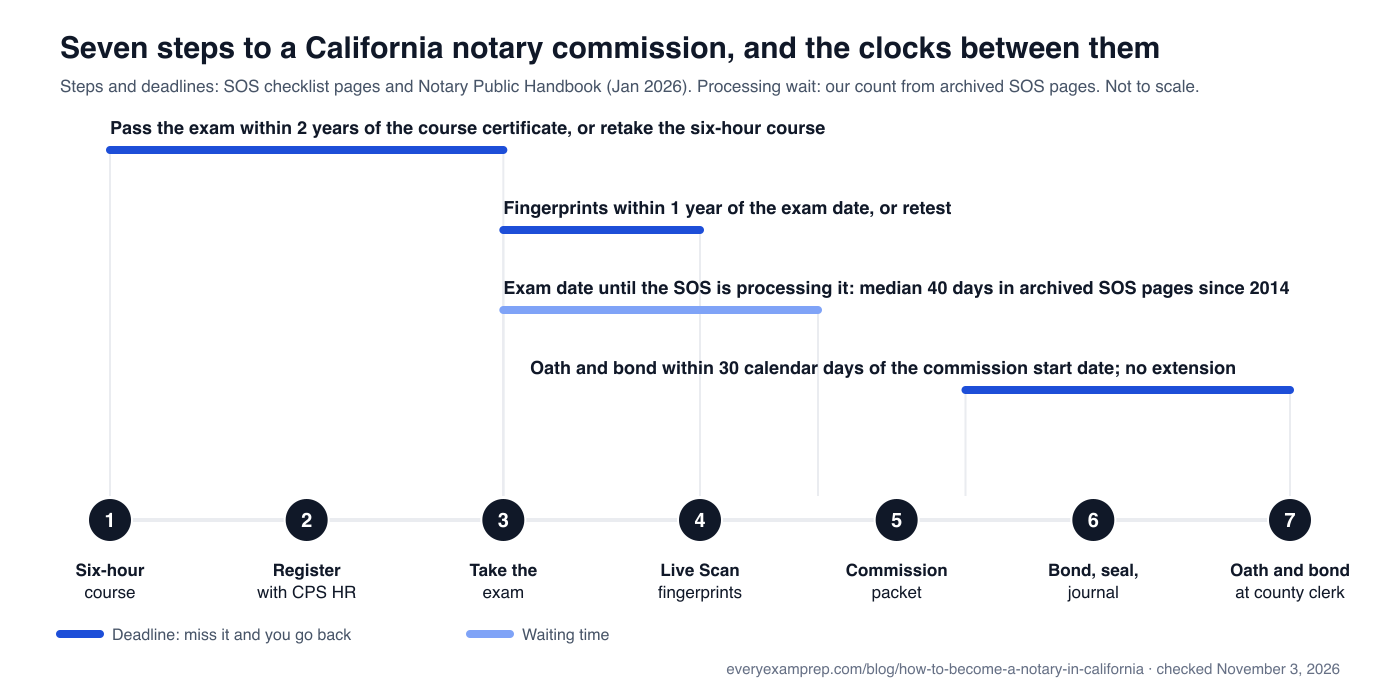
To become a notary public in California, you must be at least 18, a legal California resident, complete a six-hour course approved by the Secretary of State, pass its written exam, and clear a California DOJ and FBI background check. The Secretary of State's checklist turns that into seven steps, ending when you file your oath and $15,000 bond with the county clerk. Three deadlines along the way can undo your progress, and missing the last one means a new application and new fingerprints. The main wait sits in the middle: in archived copies of the Secretary of State's processing page, an exam date typically showed up as the one being processed 40 days after the exam (the median of 194 exam dates since 2014), and 40.5 days across 2024–2026.
The rules below come from the Secretary of State's checklist pages, FAQ and Disciplinary Guidelines, the January 2026 Notary Public Handbook, CPS HR Consulting (which runs the exam for the state) and the Department of Justice's fingerprint fee chart. For the exam itself, our California notary exam guide covers the format and our free California notary practice test follows the handbook.
Who can become a notary in California
The Secretary of State lists five requirements under Government Code section 8201: you must be 18 or older (there is no maximum age), be a legal California resident, complete an approved course of study, pass the written exam, and clear a background check.
A criminal record does not close the door automatically, but it changes the default. The application asks for every arrest awaiting trial and every conviction, including convictions dismissed under Penal Code section 1203.4 or 1203.4a, and failing to disclose one is itself a reason the Secretary of State lists for recommending denial. For a felony, or for a lesser offense involving moral turpitude or at odds with a notary's duties, the Secretary of State's Disciplinary Guidelines set denial as the recommended action. They allow a departure from that when at least 10 years (felony) or 5 years (lesser offense) have passed since probation or parole ended, or since release if neither was ordered, and even then the decision weighs other factors. A recommendation to deny can be appealed through the administrative hearing process. Separately, applicants out of compliance with child or family support orders are issued temporary term commissions.
The seven steps, in order
| Step | What you do | The clock |
|---|---|---|
| 1. Complete approved education | Take a six-hour course from a Secretary of State-approved vendor and receive a Proof of Completion certificate | The certificate is valid for 2 years; pass the exam before it expires or take the course again |
| 2. Register for the exam | Register with CPS HR Consulting at notary.cpshr.us or by phone | None set |
| 3. Take the exam | Bring photo ID, your completed application with a 2" x 2" color passport photo stapled to it, the Proof of Completion, the registration confirmation letter, and a $40 check or money order | Results in 15–20 business days; a passing result is valid for 1 year |
| 4. Live Scan fingerprints | Only after you pass; the prints go to the California DOJ and the FBI | Within 1 year of the exam date, or you retest |
| 5. Await the commission packet | Mailed once your application is approved and your background check has cleared | No published standard; see the processing data below |
| 6. Buy your bond, seal and journal | A $15,000 bond, a seal from an authorized manufacturer, and a sequential journal | Before you file |
| 7. File your oath and bond | With the county clerk where your principal place of business is | Within 30 calendar days of the commission's start date; this cannot be extended |
Step 1: the six-hour course
A first commission needs the six-hour course, and so does anyone whose earlier commission has already expired, however many terms they held. Current notaries renewing on time can take a three-hour refresher instead (see After you are commissioned). The Proof of Completion certificate is valid for two years from the date it is issued, and if you have not passed the exam by then, you take the six-hour course again. The Secretary of State approves the courses but its education page lists no price; vendors set their own.
Steps 2 and 3: register for and take the exam
You register with CPS HR Consulting, then bring your paperwork to the test center, where CPS HR says to allow about two to three hours for check-in, the exam and instructions. The name on your ID must exactly match the full legal name you print in Section 1D of the application. The fee is $40 for the exam and application processing, or $20 if you are retaking after a failed attempt, paid by check or money order to the Secretary of State; cash is not accepted at the exam site. CPS HR adds that your name must be preprinted on the check, temporary checks are not accepted, and if you are retaking, you bring a copy of your printed fail letter with the $20.
According to CPS HR Consulting, the exam is closed-book: 45 multiple-choice items in 60 minutes, reported as a scaled score from 0 to 100, where 70 passes; a scaled score is not the percentage of questions you got right. CPS HR allows one attempt per calendar month, and the Secretary of State says a score under 70 brings a fail notice with a re-take voucher. Results arrive by email or mail 15 to 20 business days after the exam, according to both the Secretary of State's FAQ and CPS HR; if 25 business days pass without them, contact CPS HR. A passing result is valid for one year from the exam date, and a passing application goes to the Secretary of State for processing. Our California notary study guide walks through the handbook topics the exam draws on.
Step 4: Live Scan fingerprints
You get fingerprinted only after you pass, and you must do it within one year of the exam date or take the exam again. Bring the Request for Live Scan Service form and keep your copy until your commission arrives. You pay two charges: a fingerprint processing fee for the background checks and a rolling fee that each Live Scan site sets for taking the prints. The Department of Justice's applicant fee chart has no notary row; its general rate for certificates, licenses and permits is $32 for the state check and $17 for the FBI check, or $49 before the rolling fee. The chart is dated August 17, 2012 and marked subject to change. No commission is issued until a report from the DOJ and the FBI comes back; you can follow yours at the DOJ's applicant status page.
Step 5: the commission packet
The packet is mailed once your application is approved and your background check has cleared. Among other things it includes your commission certificate, two Notary Public Oath and Certificate of Filing forms, and a Certificate of Authorization to Manufacture Notary Public Seals, which authorizes a manufacturer to make your seal.
Steps 6 and 7: bond, seal, journal, then the county clerk
The Secretary of State's checklist puts these purchases after the packet arrives, and the seal has to wait for it: the packet carries the list of authorized seal manufacturers and the Certificate of Authorization the maker needs. The $15,000 bond can come from any bonding or insurance company, but it does not protect you. The handbook calls it only a limited source of funds for paying claims against the notary, says it is not an insurance policy for the notary, and warns that you remain personally liable for the full damages and may have to repay the bonding company. Your seal can only be made by a Secretary of State-authorized manufacturer, and you must keep one active sequential journal of every notarial act.
Then comes the shortest deadline, and the Secretary of State says it cannot be extended. You must file your oath and bond with the county clerk within 30 calendar days of the commission's start date. You may submit them before the start date, and the Secretary of State recommends filing in person. Your commission does not take effect until they are filed, and the handbook says no exceptions are made for mail service delays, county clerk mail processing delays, or any other reason.
How not to lose your place
Three of the clocks above can undo progress you have already made:
- Take the exam with room for a retake inside the two years. Results take 15 to 20 business days and you can test only once a calendar month, so a first attempt in the certificate's last weeks leaves no time for a second.
- Go to Live Scan soon after your pass letter arrives. The one year runs from the exam date, not from the letter.
- Choose a bonding company and seal maker while you wait, and order the day the packet arrives. The 30 days count from the start date printed on the commission, not from the day you open the envelope.
How long it takes: 194 exam dates on the Secretary of State's processing page
The Secretary of State does not publish a standard processing time. It publishes a Current Processing Dates page that names an exam date. For most of its history the page said it was processing applications from that date; today it reads "We have processed all applications received with an exam date of" a given day "or earlier". When we checked on November 3, 2026, that day was September 26, 2026, 38 days earlier. The Internet Archive has made 284 captures of the page since 2014. For each exam date the page named, we took the first saved version that named it and counted the days from that exam date to the version's "last updated" date. Later versions that repeat the same exam date are left out, because "last updated" covers the whole page, including the apostille section below it, and would inflate the count.
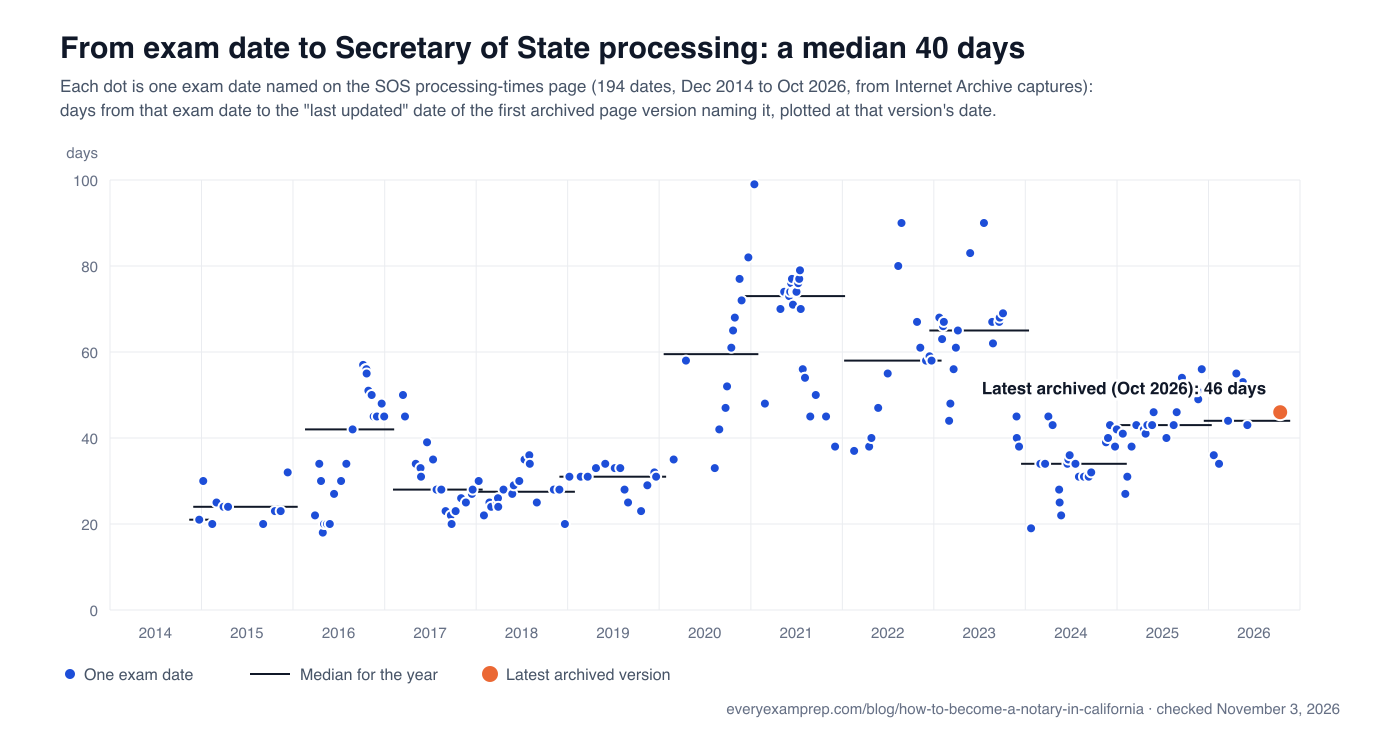
Across those 194 exam dates, plotted at the date of the page version that first named each one, the median was 40 days, ranging from 18 (exams taken on April 11, 2016, named on April 29, 2016) to 99 (exams taken on October 8, 2020, named on January 15, 2021). By year, the medians in 2015–2019 ran from 24 to 42 days. In 2020–2023 they ran from 58 to 73, with 2021 the slowest year. Since 2024 they have run from 34 to 44: the median across 2024–2026 is 40.5 days, with a range of 19 to 56. The latest archived version, from October 14, 2026, named exams taken on August 29, 2026: 46 days. One low reading may be a page error: on January 24, 2024 the page named exams from 19 days earlier, though the same page said results take at least 15 business days, which that gap does not allow.
| Year | Exam dates named | Median days | Range (days) |
|---|---|---|---|
| 2014 | 1 | 21 | 21 |
| 2015 | 9 | 24 | 20–32 |
| 2016 | 21 | 42 | 18–57 |
| 2017 | 18 | 28 | 20–50 |
| 2018 | 18 | 27.5 | 20–36 |
| 2019 | 13 | 31 | 23–34 |
| 2020 | 12 | 59.5 | 33–82 |
| 2021 | 25 | 73 | 38–99 |
| 2022 | 12 | 58 | 37–90 |
| 2023 | 19 | 65 | 38–90 |
| 2024 | 21 | 34 | 19–45 |
| 2025 | 18 | 43 | 27–56 |
| 2026 | 7 | 44 | 34–55 |
Read these numbers as one leg of the wait, not the whole of it. The count starts on your exam date, so it already covers CPS HR scoring your exam and sending your application on; versions of the page since at least 2021 say "Once exam results are available, CPS HR Consulting will then forward applications to our office for processing." It ends when the Secretary of State is working on applications from your exam date, not when your packet arrives, and it does not include a slower background check (the Secretary of State says processing depends on receiving the DOJ results), mailing, buying your bond and seal, or the county filing. Three more cautions. The Internet Archive saved the page irregularly, so some months have no data. The wording has changed: "processing applications submitted with the results of exams taken on" until 2019, "provided by CPS HR Consulting with an exam date of" in 2019 and early 2020, "processing applications received with an exam date of" from 2020, and "have processed all applications received with an exam date of … or earlier" on some 2026 versions, including the live page. And two versions from June 2020 said every application received had been processed and named no exam date, so they are not counted.
What it costs
| Item | Amount | Paid to |
|---|---|---|
| Exam and application processing fee | $40 ($20 to retake after failing) | Secretary of State |
| Exam rescoring request (optional) | $30 money order | CPS HR Consulting |
| Live Scan background checks | $32 state + $17 FBI on the DOJ's general license rate (chart dated 2012, subject to change) | Collected at the Live Scan site for the DOJ and FBI |
| Live Scan rolling fee | Varies | The Live Scan site |
| Six-hour course | Varies | The approved vendor |
| $15,000 bond | The premium varies | The bonding or insurance company |
| Seal and journal | Varies | An authorized seal manufacturer; any supplier for the journal |
The Secretary of State's own fee is the $40 (or $20 for a retake). If you dispute a failing score, CPS HR charges $30, by money order, to rescore it, and the request must reach it within 45 days of the test. Once you are commissioned, Government Code section 8211 caps what you may charge for an acknowledgment at $15 per signature.
After you are commissioned
Under Government Code section 8204, a California commission runs for four years from the date on it. Renewing is not a shortcut around the process: you take the exam again and get fingerprinted again for the new term. The one saving is the course. A three-hour refresher replaces the six-hour course, but only if you take the exam and submit your application at the exam site before your current commission expires; let it lapse first and the six-hour course is required again. CPS HR suggests testing at least six months before your commission expires and not more than twelve months ahead. The Secretary of State issues the new commission no sooner than 30 days before your current one expires.
Online notarization is not here yet: the Secretary of State's FAQ says California law still requires the signer to appear in person before the notary. Under the Online Notarization Act (SB 696, 2023), the provisions that let approved California notaries perform remote online notarizations become operative when the Secretary of State completes its Notary Automation Project 2.0, or by January 1, 2030, whichever comes first.
Free California Notary practice test — 155 questions, instant feedback. No signup required.
Sources
- 1.California Secretary of State — Requirements to Become a Notary Public — California Secretary of State (accessed Nov 3, 2026)
- 2.California Secretary of State — Complete Approved Education — California Secretary of State (accessed Nov 3, 2026)
- 3.California Secretary of State — Take the Exam — California Secretary of State (accessed Nov 3, 2026)
- 4.California Secretary of State — Submit Fingerprints via Live Scan — California Secretary of State (accessed Nov 3, 2026)
- 5.California Secretary of State — Await Commission Packet — California Secretary of State (accessed Nov 3, 2026)
- 6.California Secretary of State — Purchase Notary Public Materials — California Secretary of State (accessed Nov 3, 2026)
- 7.California Secretary of State — File Notary Public Oath & Bond — California Secretary of State (accessed Nov 3, 2026)
- 8.California Secretary of State — Notary Public Frequently Asked Questions — California Secretary of State (accessed Nov 3, 2026)
- 9.California Secretary of State — Notary Public Disciplinary Guidelines — California Secretary of State (accessed Nov 3, 2026)
- 10.California Notary Public Handbook (January 2026 edition) — California Secretary of State (accessed Nov 3, 2026)
- 11.California DOJ — Applicant Fingerprint Processing Fees — California Department of Justice (accessed Nov 3, 2026)
- 12.CPS HR Consulting — Notary Exam Information — California Secretary of State (accessed Nov 3, 2026)
- 13.California Secretary of State — Current Processing Dates (Internet Archive capture, October 14, 2026) — California Secretary of State, via the Internet Archive (accessed Nov 3, 2026)
Frequently asked questions
How long does it take to become a notary in California?
The Secretary of State publishes no standard time. In archived copies of its processing page from 2024 to 2026, an exam date showed up as the one being processed a median 40.5 days after the exam (19 to 56). Before that wait come the six-hour course and an open exam seat; after it come the background check if it is still running, the commission packet, your bond and seal, and the county filing.
How much does it cost to become a notary in California?
The Secretary of State's exam and application processing fee is $40 ($20 to retake after failing). The other costs are set by others: the Live Scan background-check fees and the site's rolling fee, the six-hour course, the premium on the required $15,000 bond, and your seal and journal.
Can I become a notary in California with a criminal record?
Sometimes, but denial is the default for a felony or a lesser offense involving moral turpitude. The Secretary of State's Disciplinary Guidelines allow a departure from that once at least 10 years (felony) or 5 years (lesser offense) have passed since probation or parole ended, and the decision still weighs other factors. You must disclose arrests pending trial and all convictions, including ones dismissed under Penal Code 1203.4 or 1203.4a; failing to disclose is itself a reason for denial. A denial recommendation can be appealed.
What score do you need to pass the California notary exam?
A scaled score of 70 out of 100, according to CPS HR Consulting, which runs the exam for the Secretary of State. It is not a percentage of questions answered correctly. CPS HR lists 45 items and a one-hour limit.
What happens if I miss the 30-day deadline to file my oath and bond?
Your commission is not valid, and you cannot act as a notary until you obtain a new appointment. The handbook says that means a new application with a current Proof of Completion certificate, a 2" x 2" color passport photo, a $20 check, and fingerprints retaken at a Live Scan site. If you were renewing on a three-hour refresher, you need the six-hour course again, because your old commission has expired.
Can California notaries notarize online?
Not yet. The Secretary of State says California law still requires the signer to appear in person. The Online Notarization Act's remote online notarization provisions become operative when the Secretary of State completes its Notary Automation Project 2.0, or by January 1, 2030, whichever is earlier.