In 2025, 86.7% of first-time, U.S.-educated NCLEX-RN candidates passed: 167,272 of 192,916, down from 91.2% in 2024. The NCLEX-PN figure was 86.6%, down from 88.4%. Across all candidates for U.S. RN licensure, including repeat test-takers and internationally educated nurses, 69.1% passed. These are NCSBN's own figures, from its annual NCLEX Examination Statistics; 2025 is the most recent complete year. The table below puts seven years of those reports side by side, with the main candidate types to one decimal place.
NCLEX pass rates by year, 2019–2025
Each figure is the annual total from that year's report: the NCLEX-RN table for U.S. licensure (Canadian-licensure candidates are reported separately and not included) and the NCLEX-PN table, both broken down by type of candidate.
| Year | RN, first-time U.S.-educated | PN, first-time U.S.-educated | RN, first-time internationally educated | RN, repeat U.S.-educated | RN, all U.S.-licensure candidates |
|---|---|---|---|---|---|
| 2019 | 88.2% | 85.6% | 45.5% | 44.0% | 72.8% |
| 2020* | 86.6% | 83.1% | 43.7% | 42.9% | 72.3% |
| 2021 | 82.5% | 79.6% | 46.8% | 45.5% | 68.9% |
| 2022 | 79.9% | 79.9% | 43.3% | 43.7% | 63.4% |
| 2023* | 88.6% | 86.7% | 52.7% | 51.1% | 69.7% |
| 2024 | 91.2% | 88.4% | 53.8% | 50.9% | 73.3% |
| 2025 | 86.7% | 86.6% | 47.3% | 52.7% | 69.1% |
* 2020: NCSBN's report says the NCLEX "required several modifications after Q1" because of COVID-19, and the maximum number of items and testing time were not the same across the four quarters; the NCLEX-PN passing standard also rose to −0.18 logits on March 25, 2020. 2023: the Next Generation NCLEX launched on April 1, so the year mixes one quarter of the old exam with three of the new one.
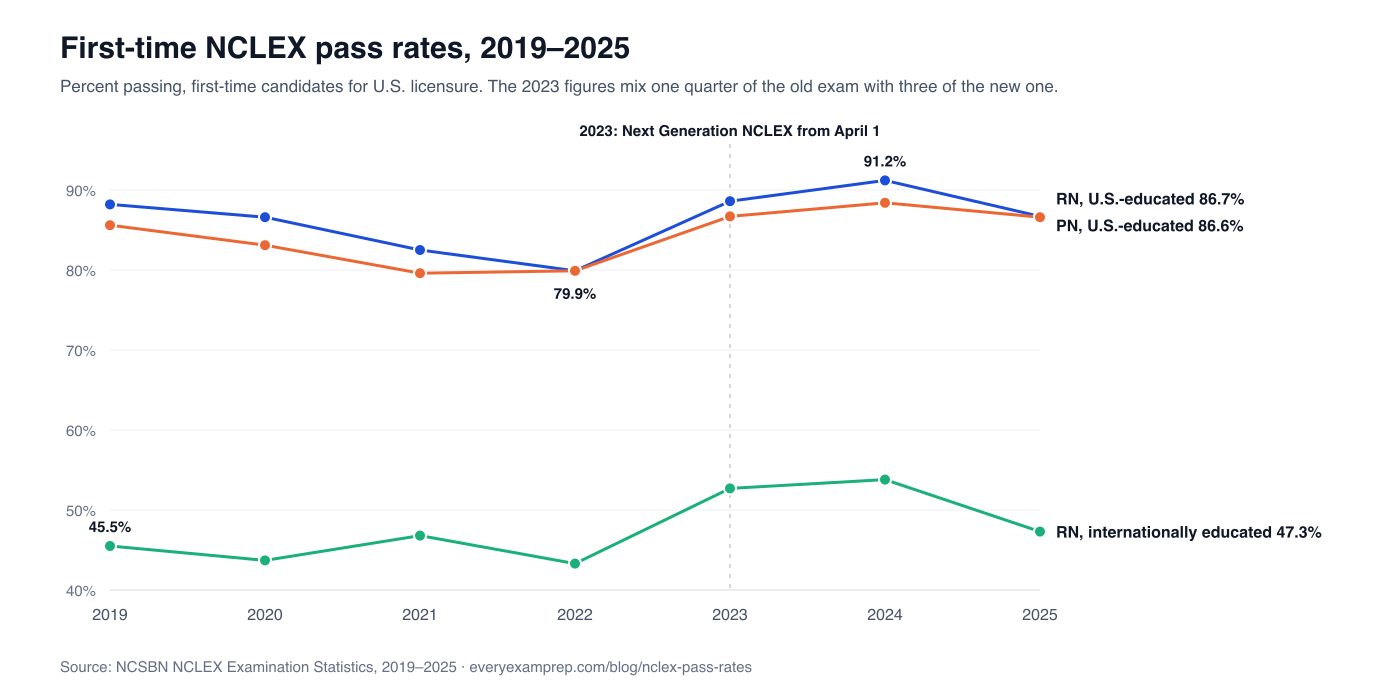
The first-time U.S. RN rate fell three years in a row, from 88.2% in 2019 to 79.9% in 2022. The PN rate reached its low a year earlier, 79.6% in 2021. The Next Generation NCLEX launched on April 1, 2023, and the RN rate was 88.6% that year and 91.2% in 2024 before falling to 86.7% in 2025; the PN rate rose to 88.4% in 2024 and was 86.6% in 2025. Within 2023, 80.5% of first-time U.S. RN candidates passed in January–March, the last quarter of the old exam, and 94.3% in April–June. In every other year from 2019 to 2025, the January–March and April–June rates were within 1.5 points of each other; in 2023 they were 13.8 points apart, and January–March 2023 drew 56,969 first-time U.S.-educated candidates, more than any other January–March in the series. NCSBN's statistics report when the rates moved, not why.
First-time, repeat and internationally educated candidates
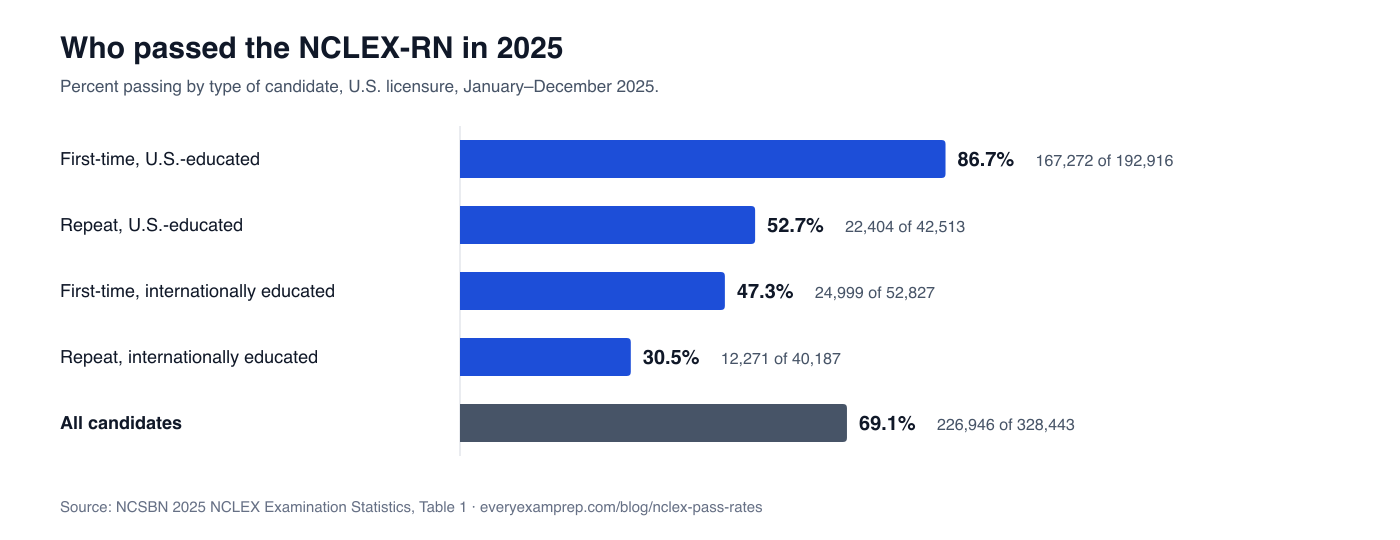
The headline 86.7% describes only first-time, U.S.-educated candidates. U.S.-educated candidates retaking the exam passed at 52.7% in 2025, first-time internationally educated candidates at 47.3%, and internationally educated repeaters at 30.5%. The internationally educated first-time rate has stayed between 43.3% and 53.8% every year since 2019. Repeat attempts are numerous: 42,513 by U.S.-educated and 40,187 by internationally educated candidates in 2025.
The October–December dip
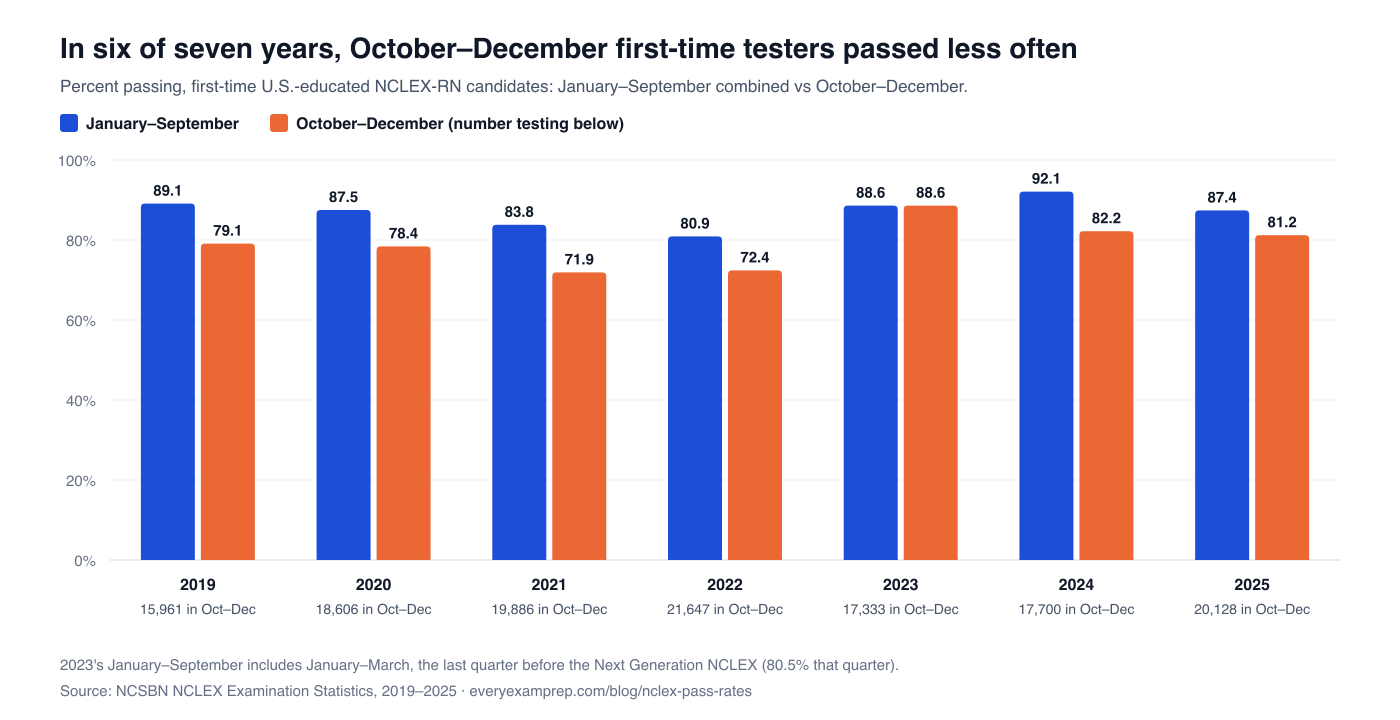
NCSBN's reports give each year by quarter, and one pattern repeats. In six of the seven years, first-time U.S.-educated candidates who tested October–December passed less often than those who tested January–September: 81.2% against 87.4% in 2025, and 82.2% against 92.1% in 2024. The exception is 2023, when both rounded to 88.6%; January–March 2023 was the last quarter of the old exam, and the new-exam quarters alone, April–September, came to 92.7%, against 88.6% in October–December. October–December is also the smallest quarter every year, 15,961 to 21,647 first-time candidates against 155,413 to 172,788 in January–September.
The reports split each quarter by program type, and in 2025 the dip appears in both of the large groups: bachelor's-degree graduates passed at 82.6% in October–December against 88.2% in January–September, and associate-degree graduates at 80.2% against 86.7%. Associate-degree graduates were about the same share of first-time candidates in both periods, 46.5% in October–December and 46.4% in January–September, so the late-year figure is not a shift from one kind of program to another. Beyond that, the statistics do not say why it is lower.
What a pass rate does and does not tell you
A pass rate is the share of a group that cleared the passing standard. It is not your chance of passing. The NCLEX-RN is scored pass or fail against a passing standard of 0.00 logits, which NCSBN has set through March 31, 2029; your result depends on your own performance against it. What the figures do show is how different the groups' results are: first-time, U.S.-educated candidates passed at 86.7% in 2025, while the other three candidate types in the RN table passed at 30.5% to 52.7%.
To prepare, work through the free NCLEX-RN practice test, follow the six-week NCLEX-RN study plan, or start from the NCLEX-RN exam overview. Practical nurses can use the NCLEX-PN overview.
Free NCLEX-RN practice test — 150 questions, instant feedback. No signup required.
Sources
- 1.NCSBN — 2019 NCLEX Examination Statistics — NCSBN (accessed Nov 3, 2026)
- 2.NCSBN — 2020 NCLEX Examination Statistics — NCSBN (accessed Nov 3, 2026)
- 3.NCSBN — 2021 NCLEX Examination Statistics — NCSBN (accessed Nov 3, 2026)
- 4.NCSBN — 2022 NCLEX Examination Statistics — NCSBN (accessed Nov 3, 2026)
- 5.NCSBN — 2023 NCLEX Examination Statistics — NCSBN (accessed Nov 3, 2026)
- 6.NCSBN — 2024 NCLEX Examination Statistics — NCSBN (accessed Nov 3, 2026)
- 7.NCSBN — 2025 NCLEX Examination Statistics — NCSBN (accessed Nov 3, 2026)
- 8.NCSBN — Next Generation NCLEX — NCSBN (accessed Nov 3, 2026)
Frequently asked questions
What is the NCLEX pass rate for 2025?
According to NCSBN's 2025 NCLEX Examination Statistics, 86.7% of first-time, U.S.-educated NCLEX-RN candidates passed in 2025 (167,272 of 192,916). Counting every candidate for U.S. RN licensure, including repeaters and internationally educated nurses, the rate was 69.1%.
What is the NCLEX-PN pass rate?
86.6% of first-time, U.S.-educated NCLEX-PN candidates passed in 2025 (47,470 of 54,818), down from 88.4% in 2024, according to NCSBN's annual statistics.
Did the NCLEX pass rate go down?
Yes, in 2025: the first-time U.S.-educated RN rate fell from 91.2% in 2024 to 86.7%. It had dropped to 79.9% in 2022 and was 88.6% in 2023, the year the Next Generation NCLEX launched on April 1. NCSBN's statistics report these changes without attributing a cause.
What is the NCLEX pass rate for international nurses?
In 2025, 47.3% of first-time internationally educated candidates for U.S. RN licensure passed, and 30.5% of internationally educated repeaters, according to NCSBN. The first-time rate has ranged from 43.3% to 53.8% since 2019.
What is the NCLEX pass rate for repeat test takers?
52.7% for U.S.-educated candidates retaking the NCLEX-RN for U.S. licensure in 2025 (22,404 of 42,513), and 30.5% for internationally educated repeaters, according to NCSBN's 2025 statistics.
Is the NCLEX pass rate the same as my chance of passing?
No. A pass rate is the share of a group that cleared the passing standard. For the NCLEX-RN, NCSBN sets that standard at 0.00 logits through March 31, 2029; your own result depends on your performance against it, not on how others did.