The ASVAB score that counts for enlistment is the AFQT, and it is a percentile from 1 to 99, not a percentage of questions answered correctly. An AFQT of 62 means you did as well as or better than 62% of a national sample of 18-to-23-year-olds tested in 1997, so the highest AFQT is 99 and 50 is the middle of that sample. The official ASVAB FAQ gives the 1-to-99 scale, the 1997 reference group and the 62 example. The Air Force describes the AFQT as a score "used, along with other criteria, to determine if you are eligible to enlist".
Each branch sets its own minimum. Where a branch's recruiting site states one, it is 31 for the Army, 31 for Air Force high school seniors and graduates (50 with a GED), 31 for the Marine Corps (50 or more with a GED or nontraditional diploma) and 32 for the Coast Guard. The Navy's requirements page and the Space Force's enlisted page say a qualifying score is required without giving a number. A good score clears your branch's minimum with room to spare: job (line) score minimums can set a higher bar, and federal law, 10 U.S.C. § 520, limits how many recruits enlisting for active duty a branch takes from the 10th to 30th percentile each fiscal year.
The ASVAB score chart: AFQT categories
AFQT percentiles fall into categories. The ranges are from the score page on officialasvab.com; the right-hand column applies the branch minimums and the law covered below.
| AFQT category | Percentile range | What it means for enlistment |
|---|---|---|
| I | 93–99 | As well as or better than at least 93% of the 1997 reference sample |
| II | 65–92 | Clears every branch-wide minimum quoted here, including the Air Force's 65 for applicants with none of its education credentials |
| IIIA | 50–64 | Clears the 50 the Air Force and Marine Corps set for GED holders |
| IIIB | 31–49 | Meets the Army's 31, the Air Force and Marine Corps diploma minimum of 31 and, from 32, the Coast Guard's |
| IVA | 21–30 | Below every minimum quoted here; inside the band federal law caps. The Army offers an academic prep course from a score of 21 |
| IVB, IVC | 16–20, 10–15 | Below every minimum quoted here; inside the band federal law caps |
| V | 1–9 | Below every minimum quoted here, and below the band the cap covers |
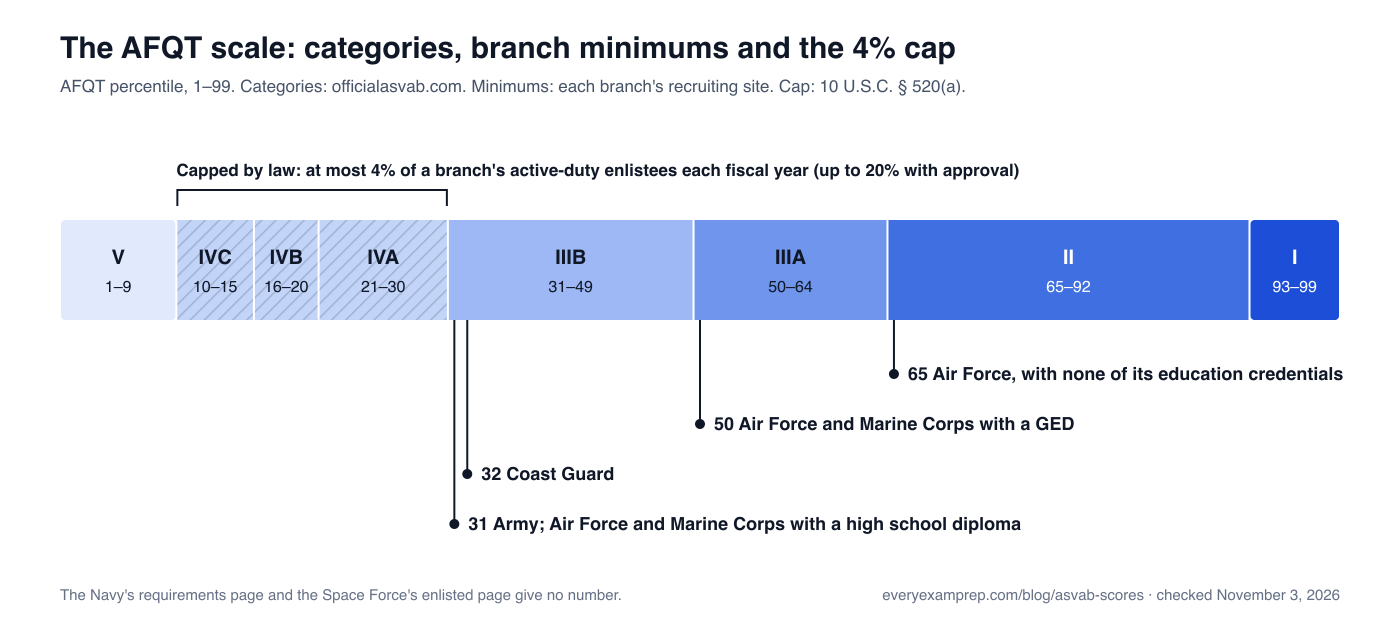
Minimum ASVAB score by branch (2026)
The branches do not publish their minimums in one place or one format. The Army's page is the plainest: "To enlist, you need an ASVAB score of at least 31." The table quotes each recruiting site as read on November 3, 2026.
| Branch | Minimum score stated | With a GED or no diploma | Source and notes |
|---|---|---|---|
| Army | 31 | Not stated separately | goarmy.com. A score of 21 opens the 90-day academic track of the Future Soldier Preparatory Course; a score of 31 to 49 can qualify for a 30-day option with one chance to improve. The Army uses your most recent score, not your highest |
| Air Force | 31 for high school seniors and graduates | 50 with a GED; 65 with none of the education credentials the join page lists | airforce.com/asvab; the join page gives a range of 31 to 65 by education level |
| Marine Corps | 31 | 50 or more with a GED or nontraditional diploma | marines.com, which calls it the "ASVAB score" |
| Coast Guard | 32 (AFQT) | Not stated separately | gocoastguard.com |
| Navy | Not stated on the two navy.com pages checked | Not stated | The requirements page says a minimum score is required; the prepare-to-join page says the overall score and line scores decide job eligibility |
| Space Force | Not stated on the enlisted page | Not stated | The enlisted page asks applicants to "obtain a qualifying ASVAB score" |
Federal law adds one floor for applicants without a high school diploma. Section 520(b) says such a person "may not be accepted for enlistment in the armed forces unless the score of that person on the Armed Forces Qualification Test is at or above the thirty-first percentile". The same subsection adds that a person "may not be denied enlistment in the armed forces solely because of his not having a high school diploma if his enlistment is needed to meet established strength requirements".
The 4 percent cap on active-duty recruits who score 10 to 30
Section 520(a) limits how many people a branch may take whose AFQT is "at or above the tenth percentile and below the thirty-first percentile". The limit counts people "originally enlisted or inducted to serve on active duty (other than active duty for training)" in a fiscal year, and it is 4 percent of that branch's total. "Upon the request of the Secretary concerned", the Secretary of Defense may let a branch go up to 20 percent, and must notify the Senate and House armed services committees within 30 days of doing so. Until Public Law 118–31 in 2023, the limit was 20 percent.
The same law added a requirement, printed as a note to section 520. When recruits covered by section 520 exceed 10 percent of a branch's enlistments in a fiscal year, the branch must run a future servicemember preparatory course. Every new enlistee below the 31st percentile must then be enrolled before initial basic training and must finish with an AFQT "at least 10 points higher" than their last score before enlisting, or at the 31st percentile or above. A recruit who makes no meaningful progress within 90 days of enlistment is separated, and a graduate who reaches the 31st percentile in the same fiscal year may be left out of the 4 percent count. The requirement expires on September 30, 2028.
For a score, this means a 31 is the first AFQT outside the capped band: it is the minimum the Army publishes and the diploma minimum of the Air Force and Marine Corps. A high school graduate scoring between 10 and 30 is not barred by section 520, but falls in the band it limits; an applicant without a diploma needs 31 under section 520(b).
How many people reach each score
Officialasvab.com defines an AFQT percentile as "the percentage of examinees in a reference group that scored at or below that particular score", so the categories and minimums translate directly into shares of that group. A category running from a to b holds about b − (a − 1) percent of it, and about 101 − s percent scored at or above a score s. Category I is the exception: percentiles are reported only up to 99, so it takes in everyone above the 92nd percentile, about 8 percent. The reference group is the national sample of 18-to-23-year-olds tested in 1997, so these shares describe that sample, not today's applicants, and they are approximate because percentiles are whole numbers.
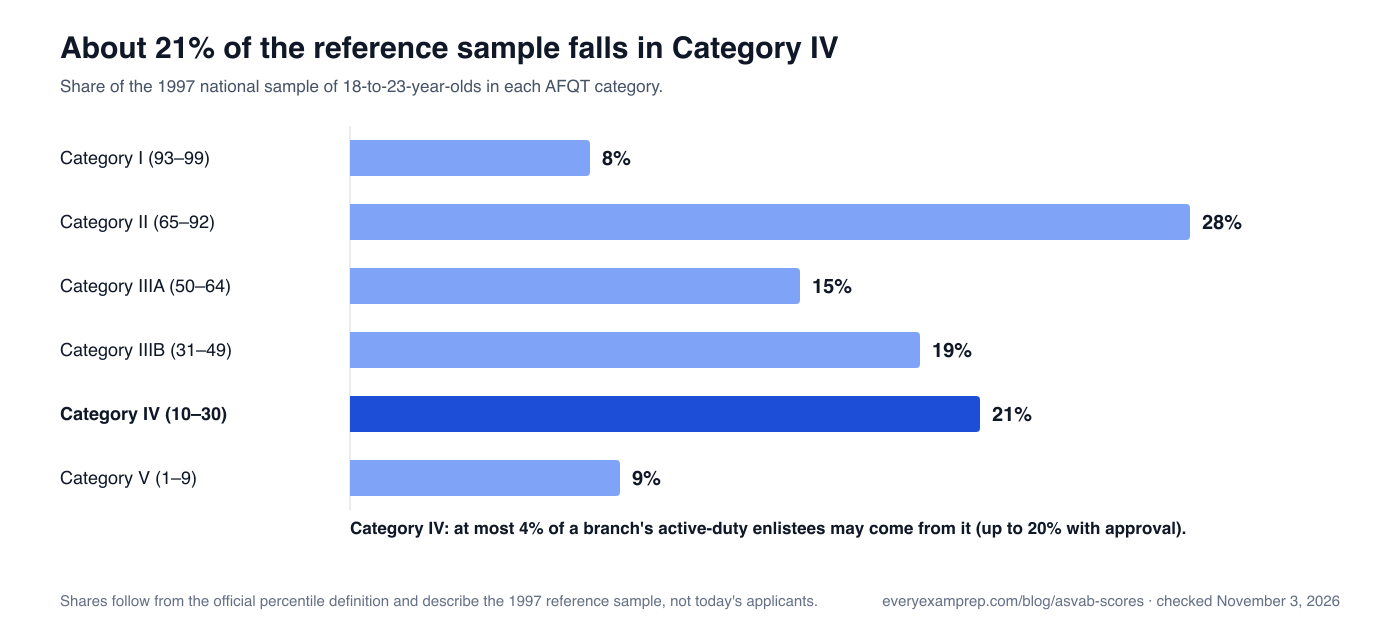
About 21 percent of the reference sample scored in Category IV, 10 to 30: more than five times the 4 percent of a branch's active-duty enlistees the law allows from that band in a fiscal year. Category II, 65 to 92, is the largest single category, at about 28 percent.
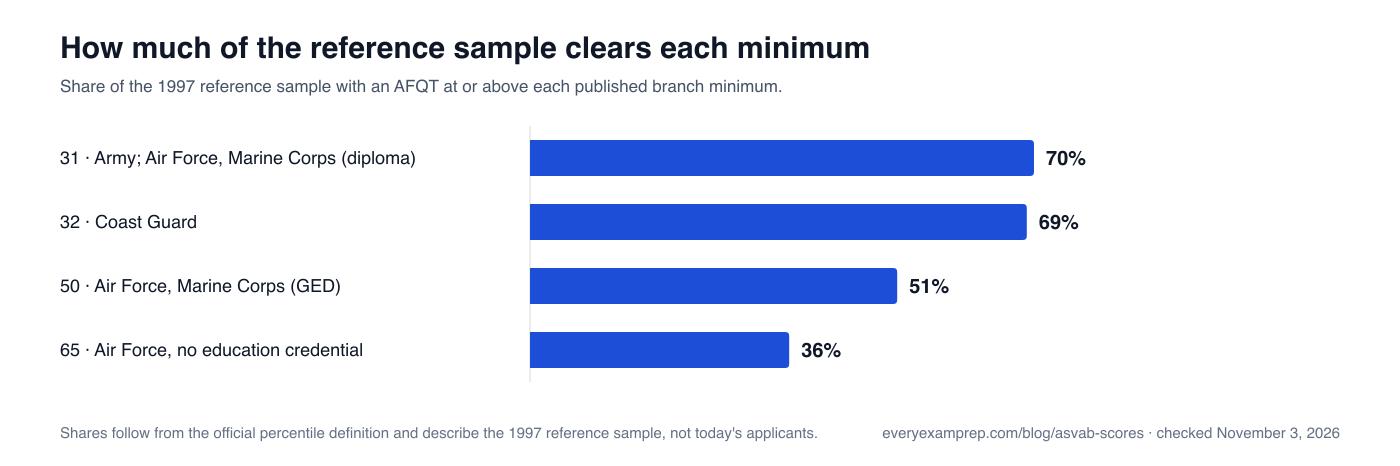
The Army's minimum of 31 is a score about 70 percent of the reference sample reached. The 50 the Air Force and Marine Corps ask of GED holders is a score about half of it reached, and the Air Force's 65 for applicants with none of its education credentials about 36 percent.
Average and highest ASVAB scores
- The highest AFQT is 99. Percentiles are reported from 1 to 99, so there is no AFQT of 100.
- 50 is the middle of the reference sample. Officialasvab.com's score and FAQ pages, read on November 3, 2026, give no average for today's applicants.
- Subtest standard scores are centered on 50 too. Officialasvab.com says about half the population scores at or above a standard score of 50, and about 16% at or above 60.
The three kinds of ASVAB score
Your score report carries more than one number, and they do different jobs.
- Standard scores, one for each subtest, normed on 18-to-23-year-olds.
- The AFQT, computed from four of those standard scores: Arithmetic Reasoning, Mathematics Knowledge, Paragraph Comprehension and Word Knowledge.
- Line scores, combinations of subtests that each branch uses to match you to jobs. The Army says its line scores "determine job opportunities across different career categories"; the Navy uses "the overall score as well as individual line scores"; the Air Force uses four composites called Mechanical, Administrative, General Aptitude and Electronics (MAGE).
Only those four subtests count toward the AFQT. The others still matter once you are eligible, because branches build line scores from subtests to decide which jobs you qualify for.
Retaking the ASVAB and how long scores last
The ASVAB retest policy requires a one-month wait before the first retest, another month before the second, and six months between any retests after that. A jump of 20 or more AFQT points within six months triggers a required confirmation test. According to the official ASVAB FAQ, scores can be used for enlistment for up to two years from the test date, and the Army says it uses your most recent score, not your highest.
To see where your math and verbal sections stand before you sit the real test, take the free ASVAB practice test, which is organized by subtest, or start from the ASVAB exam overview for the format, timing and test sites.
Free ASVAB practice test — 420 questions, instant feedback. No signup required.
Sources
- 1.Official ASVAB — Understanding Your ASVAB Scores — Official ASVAB (DoD) (accessed Nov 3, 2026)
- 2.Official ASVAB — Frequently Asked Questions — Official ASVAB (DoD) (accessed Nov 3, 2026)
- 3.Official ASVAB — ASVAB Retest Policy — Official ASVAB (DoD) (accessed Nov 3, 2026)
- 4.U.S. Army — Take the ASVAB — U.S. Army (accessed Nov 3, 2026)
- 5.U.S. Air Force — ASVAB — U.S. Air Force (accessed Nov 3, 2026)
- 6.U.S. Air Force — Join the Air Force — U.S. Air Force (accessed Nov 3, 2026)
- 7.U.S. Marine Corps — Requirements to Join — U.S. Marine Corps (accessed Nov 3, 2026)
- 8.U.S. Coast Guard — Get Started — U.S. Coast Guard (accessed Nov 3, 2026)
- 9.U.S. Navy — Requirements to Join — U.S. Navy (accessed Nov 3, 2026)
- 10.10 U.S.C. § 520 — Limitation on enlistment of persons whose AFQT score is below a prescribed level — U.S. Code, via Cornell Law School LII (accessed Nov 3, 2026)
- 11.U.S. Navy — Prepare to Join — U.S. Navy (accessed Nov 3, 2026)
- 12.U.S. Space Force — Enlisted Guardians — U.S. Space Force (accessed Nov 3, 2026)
Frequently asked questions
What is the highest ASVAB score?
99. According to officialasvab.com, AFQT scores are reported as percentiles from 1 to 99, so the highest AFQT is 99: you did as well as or better than 99% of the national reference sample. There is no AFQT of 100.
What is the average ASVAB score?
Officialasvab.com's score and FAQ pages give no average for today's test-takers. The AFQT is a percentile against a 1997 national sample of 18-to-23-year-olds, so 50 is the middle of that sample; subtest standard scores are centered the same way, with about half of the sample at or above 50.
What is a good ASVAB score?
One that clears your branch's minimum with room to spare. The branches' recruiting sites give 31 for the Army, 31 for Air Force high school seniors and graduates (50 with a GED), 31 for the Marine Corps (50 or more with a GED or nontraditional diploma) and 32 for the Coast Guard. Job (line) score minimums can set a higher bar, and 10 U.S.C. § 520 limits active-duty recruits who score from 10 to 30 to 4 percent of a branch's active-duty enlistments each fiscal year, or up to 20 percent with Secretary of Defense approval.
What is a passing score on the ASVAB?
The ASVAB has no single passing score: the branches that publish a minimum publish different ones, from 31 for the Army to 32 for the Coast Guard and 50 for Air Force and Marine Corps GED holders. 10 U.S.C. § 520(b) sets the 31st percentile as the floor for applicants without a high school diploma, and jobs then depend on line scores, the subtest combinations each branch uses.
What ASVAB score do you need for the Air Force?
According to airforce.com, an AFQT of 31 for high school seniors and graduates and 50 for GED holders. The Air Force's join page gives a range of 31 to 65 by education level and says applicants without any of the education credentials may enter with a minimum of 65. The AFQT is used along with other criteria, and Air Force jobs also depend on the MAGE composite scores.
How long are ASVAB scores good for?
Up to two years from the test date for enlistment, according to the official ASVAB FAQ. Under the ASVAB retest policy on officialasvab.com, the waits are one month, then one month, then six months between later retests, and a gain of 20 or more AFQT points within six months triggers a confirmation test. The Army says it uses your most recent score, not your highest.