Series 7 options chart: maximum gain, maximum loss and breakeven for all 16 positions, with worked examples and a calculator
16 rows, machine-readable: JSON · CSV. Free to reuse and cite with attribution to Every Exam Prep and a link to the report URL.
One option
The four building blocks. Every other row is a combination of these with each other or with stock.
- Long callBuy a callBullish
- Max gain
- Unlimited
- Max loss
- premium
- Breakeven
- strike + premium
strike $50, premium $3 → gain Unlimited, loss $3 ($300/contract), breakeven $53 - Long putBuy a putBearish
- Max gain
- strike − premium
- Max loss
- premium
- Breakeven
- strike − premium
strike $50, premium $3 → gain $47 ($4,700/contract), loss $3 ($300/contract), breakeven $47 - Short (uncovered) callSell a call, no stock ownedBearish or neutral
- Max gain
- premium
- Max loss
- Unlimited
- Breakeven
- strike + premium
strike $50, premium $3 → gain $3 ($300/contract), loss Unlimited, breakeven $53 - Short (uncovered) putSell a putBullish or neutral
- Max gain
- premium
- Max loss
- strike − premium
- Breakeven
- strike − premium
strike $50, premium $3 → gain $3 ($300/contract), loss $47 ($4,700/contract), breakeven $47
Stock plus one option
A stock position with an option written against it (income) or bought around it (insurance).
- Covered callOwn the stock, sell a callNeutral to mildly bullish (income)
- Max gain
- (strike − stock cost) + premium
- Max loss
- stock cost − premium
- Breakeven
- stock cost − premium
stock cost $48, strike $50, premium $3 → gain $5 ($500/contract), loss $45 ($4,500/contract), breakeven $45 - Protective putOwn the stock, buy a putBullish, with insurance
- Max gain
- Unlimited
- Max loss
- (stock cost − strike) + premium
- Breakeven
- stock cost + premium
stock cost $52, strike $50, premium $2 → gain Unlimited, loss $4 ($400/contract), breakeven $54 - Covered putShort the stock, sell a putNeutral to mildly bearish (income)
- Max gain
- (short sale price − strike) + premium
- Max loss
- Unlimited
- Breakeven
- short sale price + premium
short sale price $52, strike $50, premium $2 → gain $4 ($400/contract), loss Unlimited, breakeven $54 - Protective callShort the stock, buy a callBearish, with insurance
- Max gain
- short sale price − premium
- Max loss
- (strike − short sale price) + premium
- Breakeven
- short sale price − premium
short sale price $48, strike $50, premium $2 → gain $46 ($4,600/contract), loss $4 ($400/contract), breakeven $46
Vertical spreads
Buy one option and sell another of the same class and expiration at a different strike. Debit spreads want the spread to widen; credit spreads want it to narrow.
- Bull call spread (debit)Buy the lower-strike call, sell the higher-strike callModerately bullish · debit spread, wants to widen
- Max gain
- (higher strike − lower strike) − net debit
- Max loss
- net debit
- Breakeven
- lower strike + net debit
lower strike $50, higher strike $55, premium paid $4, premium received $2 (net debit $2) → gain $3 ($300/contract), loss $2 ($200/contract), breakeven $52 - Bear call spread (credit)Sell the lower-strike call, buy the higher-strike callModerately bearish · credit spread, wants to narrow
- Max gain
- net credit
- Max loss
- (higher strike − lower strike) − net credit
- Breakeven
- lower strike + net credit
lower strike $50, higher strike $55, premium received $4, premium paid $2 (net credit $2) → gain $2 ($200/contract), loss $3 ($300/contract), breakeven $52 - Bull put spread (credit)Sell the higher-strike put, buy the lower-strike putModerately bullish · credit spread, wants to narrow
- Max gain
- net credit
- Max loss
- (higher strike − lower strike) − net credit
- Breakeven
- higher strike − net credit
lower strike $50, higher strike $55, premium paid $1.50, premium received $3.50 (net credit $2) → gain $2 ($200/contract), loss $3 ($300/contract), breakeven $53 - Bear put spread (debit)Buy the higher-strike put, sell the lower-strike putModerately bearish · debit spread, wants to widen
- Max gain
- (higher strike − lower strike) − net debit
- Max loss
- net debit
- Breakeven
- higher strike − net debit
lower strike $50, higher strike $55, premium received $1.50, premium paid $3.50 (net debit $2) → gain $3 ($300/contract), loss $2 ($200/contract), breakeven $53
Straddles and combinations
A call and a put together. Long positions bet on movement; short positions bet on calm.
- Long straddleBuy a call and a put, same strike and expirationExpects a big move, either direction
- Max gain
- Unlimited
- Max loss
- total premium
- Breakeven
- strike + total premium · strike − total premium
strike $50, call premium $3, put premium $2 (total premium $5) → gain Unlimited, loss $5 ($500/contract), breakeven $45 and $55 - Short straddleSell a call and a put, same strike and expirationExpects the stock to stay put
- Max gain
- total premium
- Max loss
- Unlimited
- Breakeven
- strike + total premium · strike − total premium
strike $50, call premium $3, put premium $2 (total premium $5) → gain $5 ($500/contract), loss Unlimited, breakeven $45 and $55 - Long combination (strangle)Buy a call and a put with different strikes or expirationsExpects a big move, either direction
- Max gain
- Unlimited
- Max loss
- total premium
- Breakeven
- call strike + total premium · put strike − total premium
call strike $55, put strike $45, call premium $2, put premium $2 (total premium $4) → gain Unlimited, loss $4 ($400/contract), breakeven $41 and $59 - Short combination (strangle)Sell a call and a put with different strikes or expirationsExpects the stock to stay in a range
- Max gain
- total premium
- Max loss
- Unlimited
- Breakeven
- call strike + total premium · put strike − total premium
call strike $55, put strike $45, call premium $2, put premium $2 (total premium $4) → gain $4 ($400/contract), loss Unlimited, breakeven $41 and $59
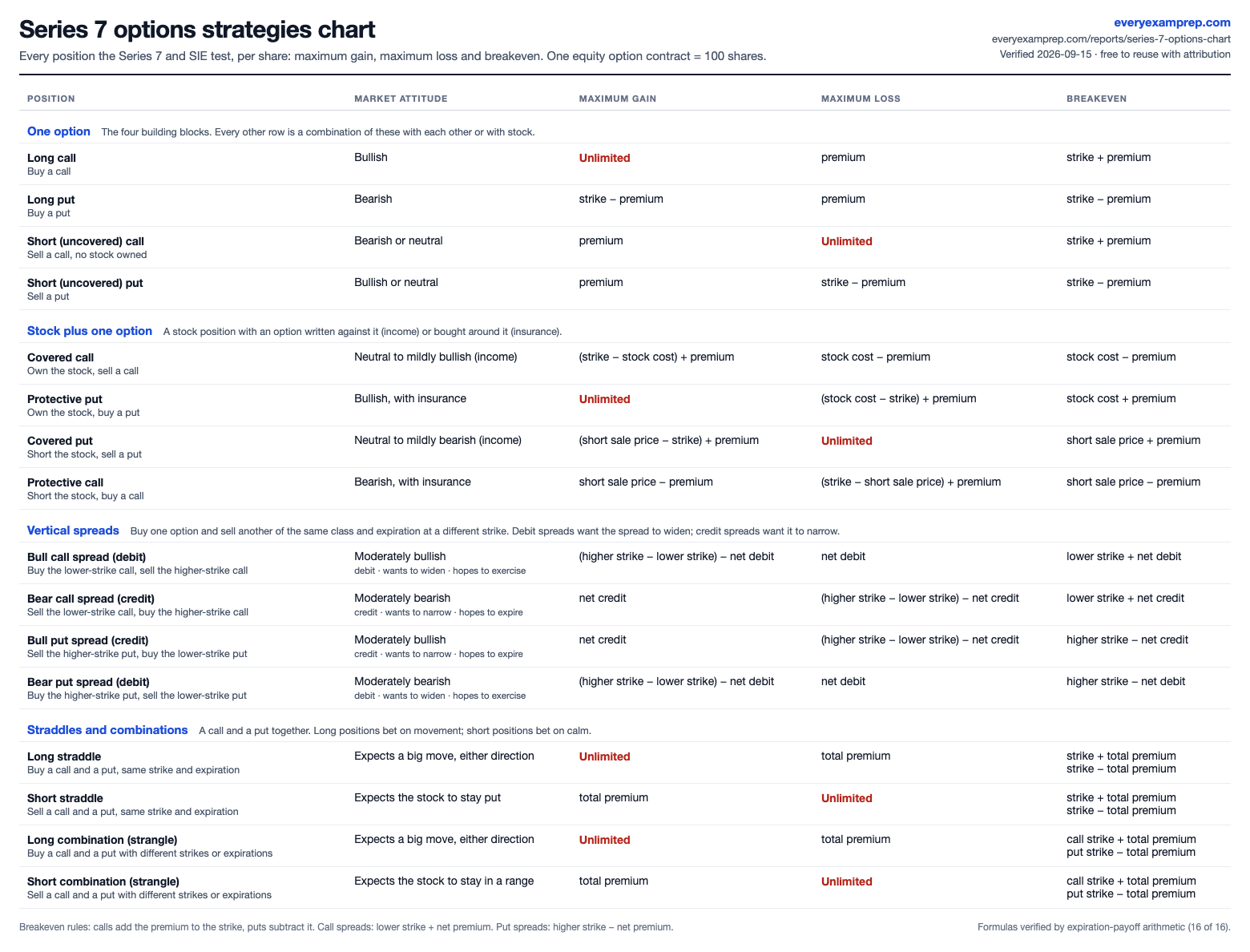
Take the chart with you
Sixteen rows, every options position the Series 7 asks about, each with the three numbers a question wants — maximum gain, maximum loss, breakeven — first as the formula in words, then worked with real prices (strike $50, premium $3 → breakeven $53, maximum loss $3 a share or $300 a contract), then as a payoff diagram. Below the chart, a calculator for your own numbers and four exam-style questions solved with the T-chart.
The formulas are not copied from a textbook. Each position is rebuilt from its legs with the sample prices, its expiration payoff is swept from a stock price of zero upward, and the printed formula has to match that arithmetic or the page does not build. Sixteen of sixteen do, and the same check runs on the worked examples and the question keys.
Reading the chart
Per share throughout; one listed equity option contract covers 100 shares, so the worked examples give the contract figure too. "Unlimited" is printed where the payoff keeps growing as the stock rises without a ceiling — it is the exam's word, and it belongs to exactly the four positions that are short a call, or short stock, with nothing above to cap the loss. The breakeven dots on each diagram sit where the profit line crosses zero.
Four rules generate every breakeven on the chart. Calls add, puts subtract: a call breaks even at strike + premium, a put at strike − premium, for buyer and writer alike. Call spreads add the net premium to the lower strike; put spreads subtract it from the higher strike, debit or credit. Straddles break even twice, at the strike plus and minus the total premium; combinations do the same from the call strike and the put strike. Stock-and-option positions break even at the stock price adjusted by the premium: minus the premium on the call side (covered call, protective call), plus the put premium on the put side (protective put, covered put).
Your own numbers: the options position calculator
Pick the position, type the strike, premium and stock price from the question, and read off the maximum gain, the maximum loss and the breakeven, per share and per contract, with the profit line drawn and a profit-and-loss row at nine stock prices around the strikes. It computes from the payoff arithmetic that verifies the chart, so it will never contradict the formulas — but it will show you, before the exam does, what a $2.50 net debit looks like at expiration.
Bullish. Rights, not obligations. The most a buyer can lose is the premium.
- Max gain
- Unlimited
- no ceiling
- Max loss
- $3
- $300 per contract
- premium
- Breakeven
- $53
- strike + premium
| Stock at expiration | $38 | $41 | $44 | $47 | $50 | $53 | $56 | $59 | $62 |
|---|---|---|---|---|---|---|---|---|---|
| Profit / loss per share | −$3 | −$3 | −$3 | −$3 | −$3 | $0 | $3 | $6 | $9 |
Per share; one listed equity contract is 100 shares. Expiration values only — no time value, dividends or commissions, which is how the exam frames it.
Four exam-style questions, worked with the T-chart
The exam gives prices, not formulas. Draw a T: money out on the left (premiums paid, stock bought, stock delivered on an exercised put), money in on the right (premiums received, stock sold, stock delivered against an exercised call). Maximum gain is the right column's best case, maximum loss the left column's worst case, and the breakeven is the stock price where the two columns are equal. One question per group of the chart; the answer keys are checked by the same payoff arithmetic as the formulas.
Question 1 · One optionAn investor buys 1 ABC Oct 40 call at 2.50 when ABC is trading at 41. What are the breakeven point and the maximum loss?Asked for: Breakeven, Maximum loss · show the worked answer
- 1T-chart. Money out: the premium, 2.50. Money in: nothing yet — a long call only pays if it is exercised or sold.
- 2Breakeven for a call is strike + premium: 40 + 2.50 = 42.50. Above 42.50 the investor profits; the stock's current price of 41 is a distraction.
- 3Maximum loss is the premium paid: 2.50 per share, $250 for the contract. Maximum gain is unlimited.
Profit line at expiration; dots mark the breakevens.
Question 2 · Stock plus one optionAn investor buys 100 shares of XYZ at 62 and writes 1 XYZ Nov 65 call at 3. What are the maximum gain and the breakeven point?Asked for: Maximum gain, Breakeven · show the worked answer
- 1T-chart. Money out: 62 for the stock. Money in: 3 in premium now, and 65 if the call is exercised and the stock is called away.
- 2Maximum gain is (strike − stock cost) + premium: (65 − 62) + 3 = 6 per share, $600 for the position. The call caps the upside at 65.
- 3Breakeven is stock cost − premium: 62 − 3 = 59. The premium lowers the price at which the stock position starts losing money.
Profit line at expiration; dots mark the breakevens.
Question 3 · Vertical spreadsAn investor buys 1 DEF Jan 50 put at 4 and sells 1 DEF Jan 45 put at 1.50. What are the maximum gain, the maximum loss and the breakeven?Asked for: Maximum gain, Maximum loss, Breakeven · show the worked answer
- 1Net premium: 4 paid − 1.50 received = 2.50 net debit. Buying the higher-strike put makes this a bear put spread, opened for a debit.
- 2Maximum loss on a debit spread is the net debit: 2.50 per share, $250. Maximum gain is (higher strike − lower strike) − net debit: (50 − 45) − 2.50 = 2.50, also $250.
- 3Put spreads break even at the higher strike minus the net premium: 50 − 2.50 = 47.50. The investor wants DEF below 47.50 by January, and both puts in the money.
Profit line at expiration; dots mark the breakevens.
Question 4 · Straddles and combinationsAn investor sells 1 GHI Mar 30 call at 2 and sells 1 GHI Mar 30 put at 1.50. What are the breakeven points, the maximum gain and the maximum loss?Asked for: Breakevens, Maximum gain, Maximum loss · show the worked answer
- 1Total premium received: 2 + 1.50 = 3.50. A short straddle has two breakevens, the strike plus and minus the total premium: 33.50 and 26.50.
- 2Maximum gain is the total premium, 3.50 per share or $350, earned if GHI closes exactly at 30 and both options expire worthless.
- 3Maximum loss is unlimited: the short call has no ceiling as GHI rises. On the downside the loss is large but finite — 30 − 3.50 = 26.50 per share if GHI goes to zero.
Profit line at expiration; dots mark the breakevens.
More of these, scored: the options questions in the free Series 7 practice test and the SIE practice test, each with a worked explanation.
Where options sit on the Series 7 and the SIE
FINRA's Series 7 content outline (October 2025) allocates 91 of 125 scored questions, 73%, to Function 3, "Provides Customers with Information About Investments, Makes Recommendations, Transfers Assets and Maintains Appropriate Records". Its Options section names "Protective put for equity and index options", "Covered call and put writing for equity options", "Long (debit) and short (credit) spreads", "Straddle/combination for equity and index options" and "Uncovered (naked) call or put writing" — the sixteen rows above — and then "Profit and loss calculations, break-even points, economics of positions". FINRA does not publish a per-topic question count.
The SIE tests the vocabulary rather than the arithmetic: what a call and a put are, who holds the right and who takes the obligation, and which positions carry unlimited risk. FINRA's investor page on options puts it in one sentence: "In the case of an uncovered, or naked, call, where an investor sells a call option without owning the underlying stock, the maximum loss is theoretically unlimited." The chart's four red cells are the positions that share that property.
Method
- — Each position is defined by its legs (stock long or short at a price; calls and puts long or short at a strike and premium). Its printed formulas are expressions over those variables — "(higher strike − lower strike) − net debit" — rendered in words for the page and evaluated with sample prices in the test suite.
- — For every position the expiration payoff is computed at a stock price of zero, at every strike and stock price in the position, and at a point beyond the highest of them. The maximum gain, maximum loss and every zero crossing found that way must equal the printed formulas evaluated on the same sample prices, to six decimal places, or the test fails and the site does not build. The worked examples and the four question keys are checked the same way.
- — "Unlimited" is assigned by the payoff's slope beyond the highest strike: a payoff still rising there has no maximum gain, one still falling has no maximum loss. Per-share figures throughout; a contract is 100 shares. The diagrams and the calculator draw the same profit function; expiration values only, with no time value, dividends or commissions.
- — Exam relevance and the definitions are FINRA's: the Series 7 content outline dated October 2025 (structure of the exam and the Options section under Function 3) and FINRA's investor page on options. The four questions are original and are not, and do not resemble, live exam items. Every Exam Prep is not affiliated with FINRA or the Options Clearing Corporation.
Sources
The documents this page was checked against, with the date each was read. Every number above traces to one of them.
- 1Series 7 — General Securities Representative Exam, Content Outline (October 2025) — FINRA, read September 15, 2026.Structure of the exam (125 scored items, four functions, Function 3 = 91 items / 73%) and the Options section under Function 3, including "Profit and loss calculations, break-even points, economics of positions".
- 2Options — investor guide — FINRA, read September 15, 2026.Definitions of a call, a put, the premium and the strike price, and the statement that an uncovered call's maximum loss is theoretically unlimited.
- 3Securities Industry Essentials (SIE) Exam — content outline sections — FINRA, read September 15, 2026.Options as a product within "Understanding Products and Their Risks" (44% of the SIE, 33 questions).
Questions
- What is the breakeven on a call option?
- Strike price plus premium, for the buyer and the writer alike. On a put it is the strike minus the premium. The buyer profits beyond that price, the writer profits short of it. A 40 call bought at 2.50 breaks even at 42.50.
- Which options positions have unlimited risk?
- Four on the chart: the uncovered (naked) call, the covered put, the short straddle and the short combination. Each is short a call — or short stock — with nothing above it to cap the loss as the stock rises. FINRA's investor page on options calls the naked call's maximum loss "theoretically unlimited".
- Does a debit spread want the spread to widen or narrow?
- Widen. A debit spread profits when the difference between the two premiums grows toward the difference between the strikes, which happens when both options finish in the money and are exercised. A credit spread wants the opposite: the spread to narrow and both options to expire worthless, so the writer keeps the net credit.
- How do you find the breakeven on a spread?
- Call spreads: lower strike plus the net premium. Put spreads: higher strike minus the net premium. The rule is the same whether the spread was opened for a debit or a credit; only which side of the breakeven is profitable changes. A 50/45 put spread opened for a 2.50 debit breaks even at 47.50.
- How many options questions are on the Series 7?
- FINRA does not publish a per-topic count. Its October 2025 content outline places options inside Function 3, which carries 91 of the 125 scored questions (73%), alongside the other products and recommendations; candidates and instructors commonly report options as one of the largest single topics in that function, but that is experience, not a published figure.
- What is the maximum loss on a covered call?
- The stock's cost minus the premium received, per share — the loss if the stock goes to zero. Stock bought at 62 with a 65 call written at 3: maximum loss 59 a share, breakeven 59, maximum gain (65 − 62) + 3 = 6 a share or $600 a contract. The premium is the only cushion; the short call adds no protection below the strike, it only caps the gain above it.
- Is there a free Series 7 options chart PDF?
- Yes. The chart downloads as a one-page letter-landscape PDF and as a 1560×1188 PNG, free to reuse with attribution; the embed code links the image back to this page so the source stays visible.
- Are options strategies on the SIE as well as the Series 7?
- The SIE covers options as a product — calls, puts, rights and obligations, which positions carry unlimited risk — while the Series 7 adds the strategies and the profit, loss and breakeven arithmetic. FINRA's Series 7 outline lists spreads, straddles, combinations, covered writing and hedging under Function 3, which carries 91 of the 125 scored questions.
Citing this page? Link to https://www.everyexamprep.com/reports/series-7-options-chart and include the verification date — the formulas do not change, but the exam that tests them does.